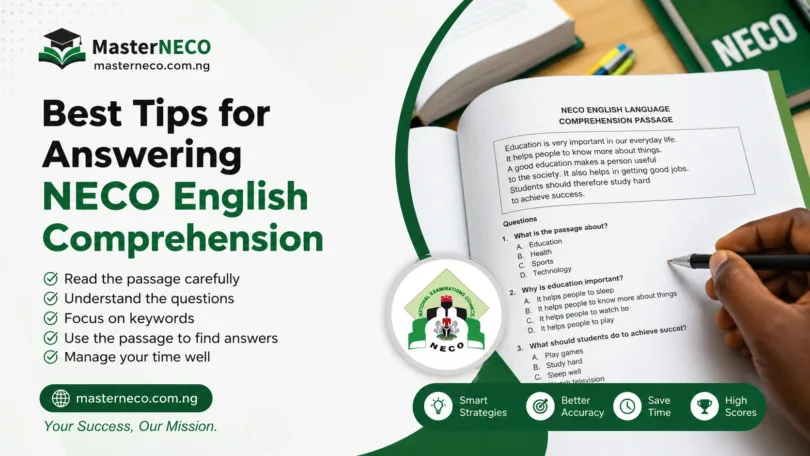
This guide provides practical, tested tips for answering NECO English Comprehension that will help you approach passages confidently and select correct answers consistently.
NECO English Comprehension remains one of the most challenging sections for Nigerian secondary school students preparing for the National Examination Council exam. Every year, thousands of students struggle not because they lack intelligence, but because they approach comprehension questions without a clear strategy.
The difference between a student who scores excellently and one who struggles often comes down to technique, preparation, and understanding what examiners are actually looking for.
Understanding the NECO English Comprehension Format
Before diving into strategies, you need to understand what you’re dealing with. NECO English Comprehension typically presents a passage ranging from 300 to 400 words, followed by 10 to 15 multiple-choice questions. The questions test your ability to understand the main idea, identify supporting details, interpret vocabulary in context, and make inferences from the text.
The challenge isn’t just reading. It’s reading strategically and knowing where to find specific information quickly.
Best Tips for Answering NECO English Comprehension In 2026
Tip 1: Read the Questions First, Then the Passage
Most students read the passage first and then look at the questions. This approach wastes time and floods your mind with irrelevant details. Instead, reverse this process.
Start by reading all the questions before you read the passage. This approach serves multiple purposes. First, it tells you exactly what information the examiners expect you to find. Second, it trains your brain to scan for specific details as you read. Third, it prevents you from getting lost in elaborate descriptions or complex sentence structures that don’t matter for the actual questions.
When you read questions first, you know whether you should focus on the author’s main argument, specific facts, character intentions, or word meanings. This targeted approach saves 3 to 5 minutes on each comprehension section.
Tip 2: Use Strategic Annotation During Reading
Active reading is different from passive reading. As you go through the passage the second time, mark important information. Underline topic sentences, circle unfamiliar words, and put question marks next to confusing sentences.
This strategy works because:
- It keeps your mind engaged with the material
- It provides visual reference points when you return to the passage for answers
- It prevents the common mistake of forgetting where key information was located
- It helps you distinguish between main ideas and supporting details
However, avoid over-annotating. Mark only what directly relates to the questions you identified. Excessive highlighting defeats the purpose and slows you down.
Tip 3: Master Vocabulary in Context
NECO regularly tests your ability to determine word meanings from surrounding text. You won’t have a dictionary during the exam, so this skill is critical. When you encounter an unfamiliar word, read the entire sentence and the sentences around it.
Look for context clues such as:
- Direct definitions within the passage
- Synonyms or antonyms near the word
- Examples that clarify meaning
- The overall tone and subject matter
For example, if a passage states “The politician’s obfuscation of the real issues frustrated many voters,” you can determine that obfuscation means hiding or making unclear, based on the context of frustrating voters.
Practice this skill regularly. Studies show that students who excel at vocabulary in context improve their comprehension scores by up to 20 percent within two months of focused practice.
Tip 4: Distinguish Between Main Idea and Supporting Details
NECO comprehension questions frequently ask about the main idea or primary purpose of a passage. Many students fail these questions because they confuse main ideas with supporting details. The main idea is the central message the author wants you to understand. Everything else supports this primary message.
A helpful technique is to ask yourself: “If the passage was reduced to one sentence, what would it be?” That sentence is your main idea. Supporting details are facts, examples, or explanations that help readers understand the main idea better.
Tip 5: Don’t Rely on Outside Knowledge
One significant mistake students make is answering based on what they know rather than what the passage states. NECO comprehension tests reading comprehension, not your general knowledge. Even if you know something contradicts the passage, you must choose answers based on what the author wrote.
This distinction matters tremendously. Multiple-choice options often include answers that sound correct based on real-world knowledge but contradict the passage. Always let the passage guide your answers.
Tip 6: Practice Inference Questions Carefully
Inference questions ask what can be concluded from the passage, even if directly stated. The difference between inference and fact-based questions requires careful reading.
For inference questions, look for:
- Implied meanings rather than explicit statements
- Patterns in the author’s language and tone
- What the author’s word choices reveal about their perspective
- Reasonable conclusions that follow from provided information
Avoid making wild guesses or drawing conclusions that require outside information. The correct inference should be strongly supported by passage content.
Common Mistakes and How to Avoid Them
| Mistake | Why It Happens | How to Fix It |
|---|---|---|
| Selecting answers from outside knowledge | Students answer based on what they know, not the passage | Force yourself to locate supporting evidence in the text |
| Misunderstanding the question | Reading questions too quickly | Read each question twice slowly before answering |
| Getting stuck on difficult sentences | Focusing on every word rather than overall meaning | Skip difficult sentences initially; return if a question requires that information |
| Poor time management | Spending too long on one passage | Allocate 20 to 25 minutes per comprehension passage maximum |
| Choosing answers that sound sophisticated | Picking complex-sounding options | Test each option against the passage; correct answers should be clearly supported |
| Missing the main idea | Focusing on details | Read the opening and closing sentences first to identify the main point |
Recommended Study Resources and Tools
| Resource Type | Examples | Cost | Effectiveness |
|---|---|---|---|
| Past NECO Papers | Official NECO question booklets from 2020-2025 | Low (₦1,000-3,000) | Very High; authentic questions match exam style |
| Online Prep Platforms | Test preparation websites, comprehension practice apps | Medium (₦2,000-5,000/month) | High; interactive feedback helps identify weak areas |
| English Textbooks | Recommended secondary school English texts | Low-Medium (₦3,000-7,000) | Medium; useful for grammar foundation but limited comprehension practice |
| Tutoring Services | Professional NECO preparation centers | High (₦5,000-15,000/session) | Very High; personalized instruction accelerates improvement |
| Study Groups | Peer-led review sessions | Free to Low | Medium; motivation and accountability increase, but quality depends on group members |
| Mobile Learning Apps | NECO-focused education apps | Free to Medium (₦500-2,000) | Medium-High; flexibility in learning schedule, good for consistent practice |
READ ALSO: NECO Past Questions and Answers PDF Download 2026/2027
Tip 7: Perfect Your Time Management Strategy
Time pressure creates panic, which ruins comprehension performance. With typical NECO English papers, you have about 90 minutes for all sections. For comprehension specifically, allocate 20 to 25 minutes per passage.
Divide this time as follows:
- Read questions (2 minutes)
- Read passage with annotation (5 minutes)
- Answer questions (15 to 18 minutes)
If you find yourself spending more than 2 minutes on a single question, skip it temporarily. Answer all other questions first, then return to difficult ones if time allows.
Tip 8: Develop a Question-Answering Sequence
Not all questions are equally difficult. Questions about main ideas and vocabulary are usually simpler. Questions requiring inference or detailed analysis are typically harder. Answer easier questions first to build confidence and ensure you capture available points.
A logical sequence looks like:
- Vocabulary in context questions
- Direct fact questions
- Main idea questions
- Inference questions
- Complex analysis questions
This approach guarantees you earn maximum points even if time runs short.
Tip 9: Study Real Past Papers Systematically
Nothing beats practicing with actual NECO papers. The language, question styles, and difficulty levels in real papers reflect exactly what you’ll face. Find papers from the last 5 years and work through them under timed conditions.
After completing each practice paper, review every single question, not just incorrect ones. Understanding why correct answers work and why incorrect options don’t teaches you the examiner’s thought process.
Tip 10: Build Your Reading Stamina
Comprehension fatigue is real. Your brain gets tired from sustained reading and concentration. Build your reading stamina by practicing comprehension passages daily, even for just 20 minutes. Consistent practice trains your brain to maintain focus and process complex information more efficiently.
Start with shorter passages and progressively increase length and difficulty. This gradual progression prevents overwhelm while steadily building your comprehension capacity.
Final Preparation Strategy
Two weeks before your NECO exam, shift from learning new techniques to reinforcing what you’ve learned. Take full-length practice tests under exam conditions. This builds confidence, identifies remaining weak areas, and trains your body to handle the mental demands of the actual exam.
Sleep well before exam day. A rested mind processes information faster and makes better decisions. Arrive early to the exam center, read instructions carefully, and execute the strategies you’ve practiced.
Frequently Asked Questions
Q: How many times should I read the comprehension passage?
A: Read it twice. First, skim the questions to know what you’re looking for. Second, read the entire passage carefully, taking notes. A third reading is unnecessary and wastes precious time.
Q: What should I do if I don’t understand a word in the passage?
A: Use context clues from surrounding sentences. If the word isn’t critical to answering questions, skip it temporarily. Most NECO passages are designed so you can understand main ideas even with some vocabulary gaps.
Q: Is it better to guess randomly or leave comprehension questions blank?
A: Guess intelligently. Eliminate obviously wrong answers first, then choose between remaining options. Random guessing gives you a 25 percent chance with four-option questions, while leaving it blank gives you zero percent.
Q: How much time should I spend on NECO English Comprehension daily?
A: Aim for 30 to 45 minutes daily for at least three months before the exam. This consistent practice produces better results than cramming for longer periods occasionally.
Q: Can I improve my comprehension score without taking professional tutoring?
A: Yes. Self-study with past papers, strategic reading practice, and disciplined application of techniques yields significant improvements. Tutoring accelerates progress but isn’t mandatory for success.
Q: What’s the most common mistake students make in NECO comprehension?
A: Answering based on outside knowledge instead of passage content. Always choose answers that the passage directly supports.
Conclusion
Mastering NECO English Comprehension requires understanding the format, developing systematic strategies, and practicing consistently. The tips outlined here represent proven techniques used by high-performing students. Start implementing them today, practice with real past papers, and approach your NECO exam with confidence. Success in comprehension isn’t about intelligence. It’s about preparation, technique, and disciplined practice. Your score improvement will follow naturally.






Leave a Comment