Are you searching for the NECO Physics Questions and Answers 2026/2027 (Objective & Essay)? You’re in the right place.
QUESTIONS
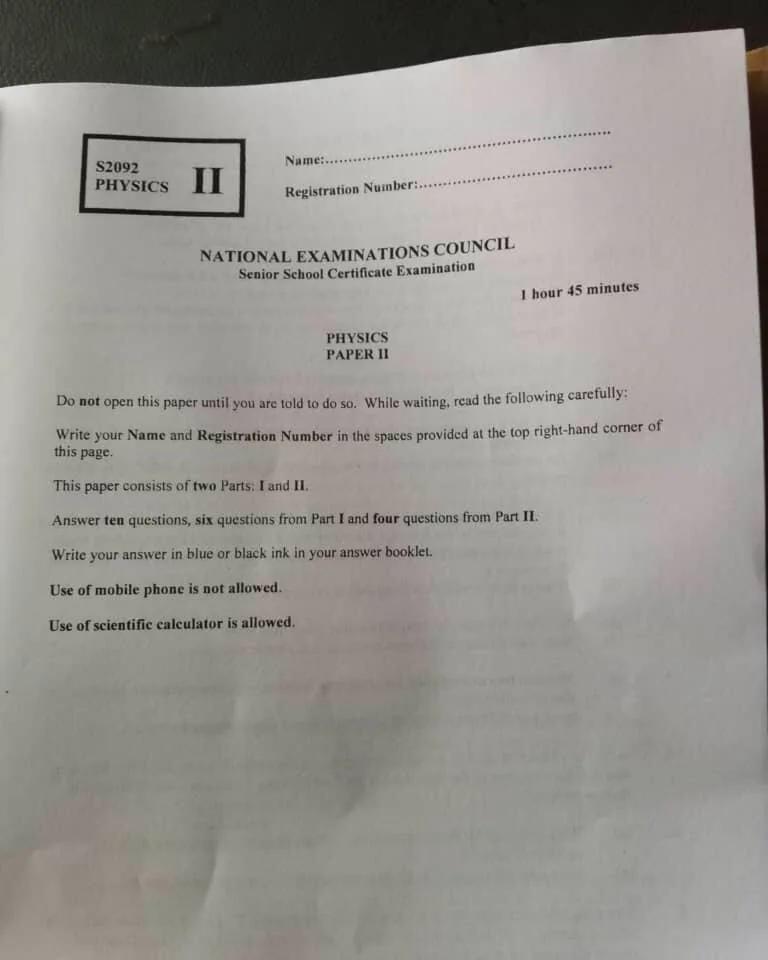
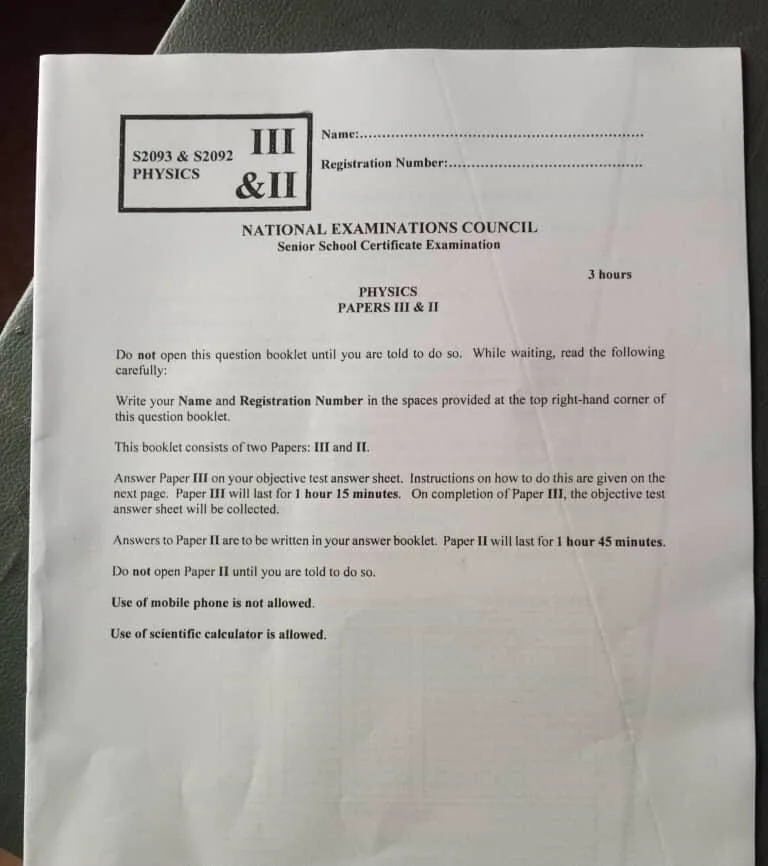
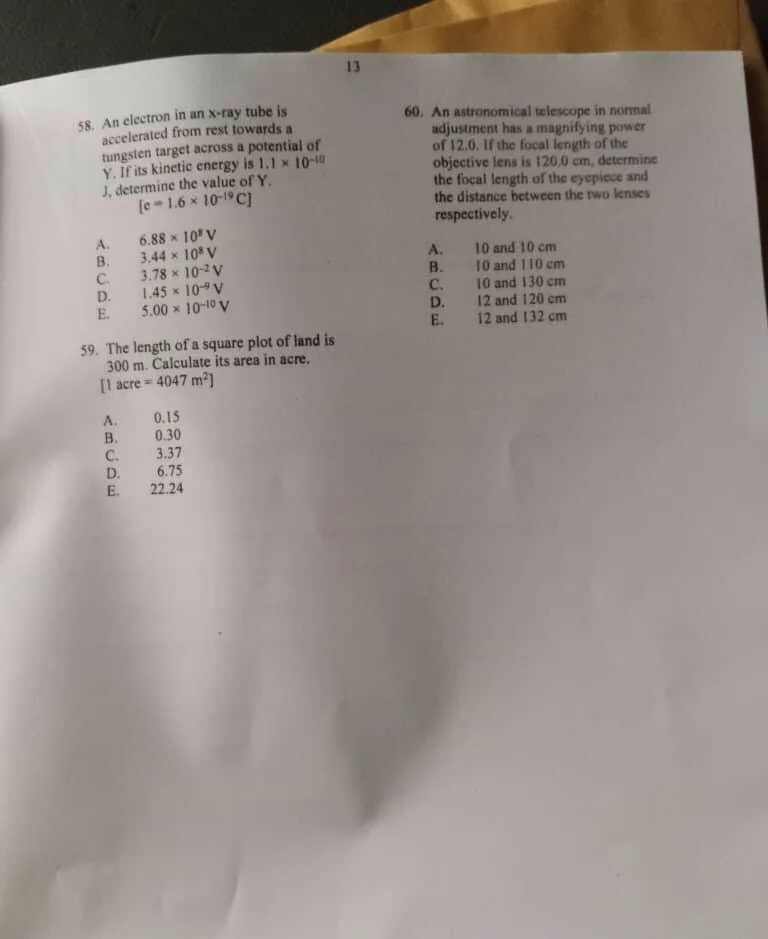
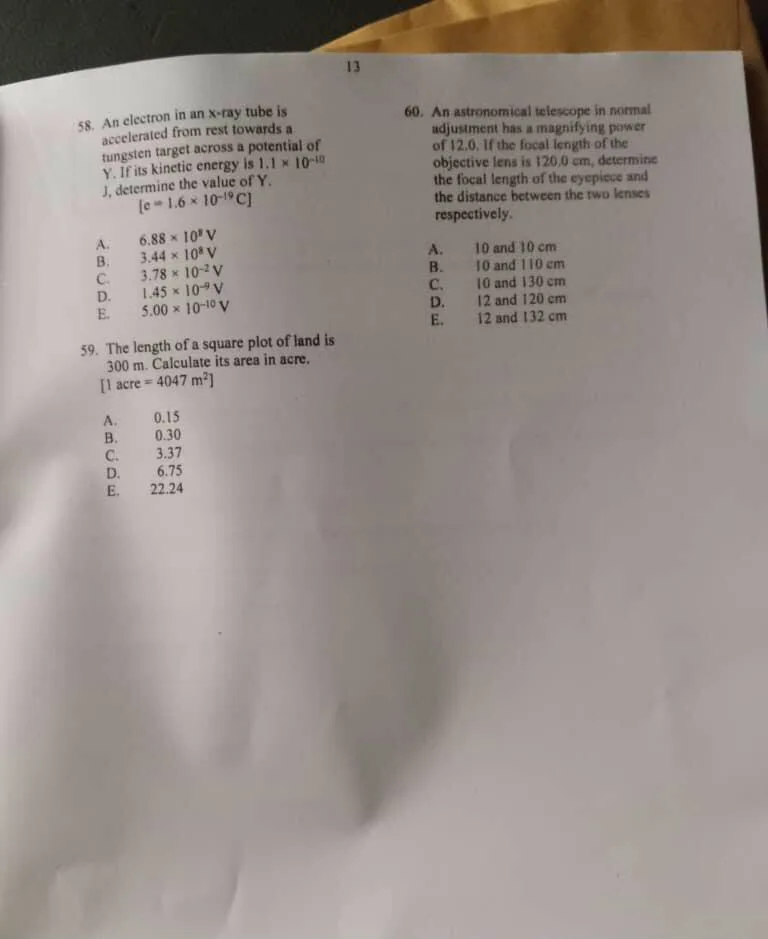
NECO Physics 2026 OBJ ANSWERS
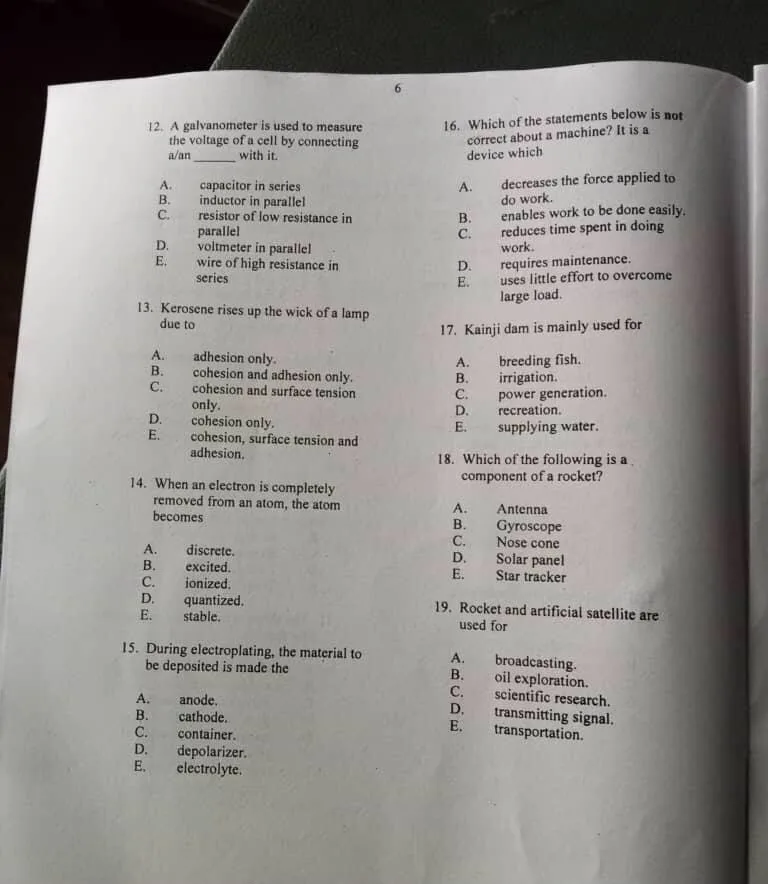
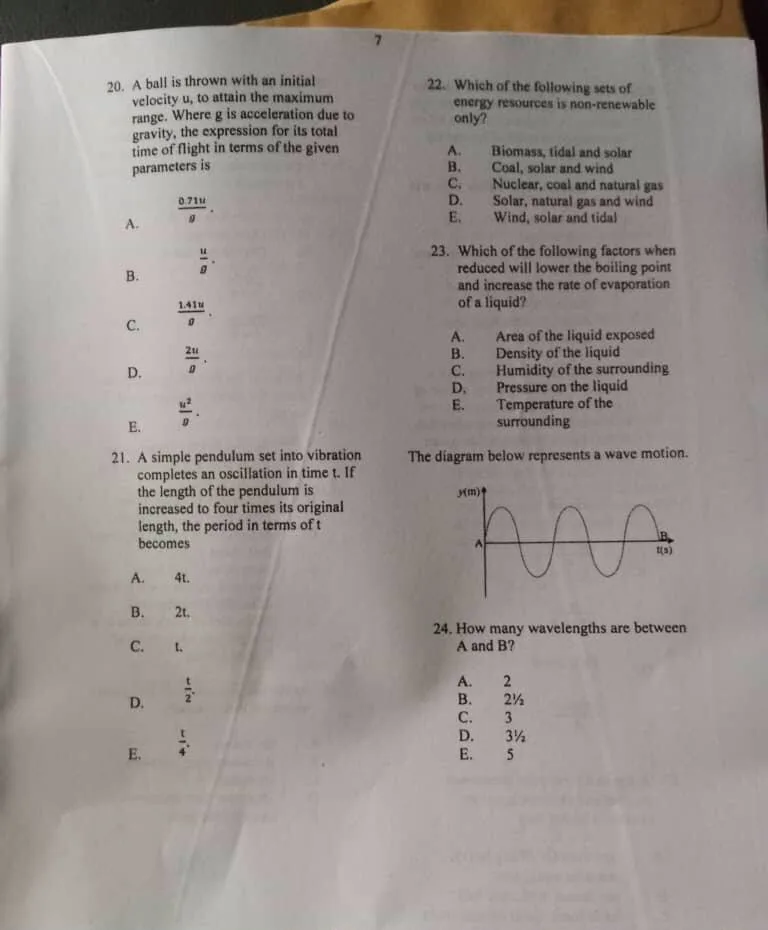
01-10: BAEDEDCCEE
11-20: DEECBCCCCC
21-30: BCDDBACDEA
31-40: ACDCAECEAE
41-50: CEECDCADCD
51-60: EEBDBDAAEC
NECO Physics Essay Answers 2026/2027
(1a)
(i) Armature (soft iron core wound with insulated copper wire)
(ii) Field magnet (permanent magnet or electromagnet)
(1b)
A flat plate collector absorbs both direct and diffuse solar radiation over its full surface area without concentrating it, and is used mainly for low-temperature applications like water heating. WHILE A focusing (concentrating) collector uses mirrors or lenses to concentrate sunlight onto a small receiver area, producing much higher temperatures, but can only make use of direct radiation and must track the sun.
(1c)
Magnifying power of microscope = Magnification of objective × Magnification of eyepiece
20 = 4 × M(eyepiece)
M(eyepiece) = 20/4 = 5
NUMBER 3
(3a)
T = 2π√(L/g)
(3b)
ω = 0.5π rad/s
T = 2π/ω = 2π/(0.5π)
T = 4 s
(4a)
Taking P’s direction as positive:
u(P) = 30 ms⁻¹, u(Q) = −15 ms⁻¹ (opposite direction), m(Q) = 10 kg, common final velocity v = 25 ms⁻¹
By conservation of momentum:
m(P)u(P) + m(Q)u(Q) = (m(P) + m(Q))v
30m(P) + 10(−15) = (m(P) + 10)(25)
30m(P) − 150 = 25m(P) + 250
5m(P) = 400
m(P) = 80 kg
(4b)
It is an inelastic collision (specifically a perfectly inelastic collision, since kinetic energy is not conserved and both bodies move with the same final velocity after collision).
(5a)
(i)Inclined plane
(ii) Pulley
(5b)
Potential energy is the energy possessed by a body due to its position or state, while kinetic energy is the energy possessed by a body due to its motion.
(6a)
(i) Ultraviolet rays
(ii) X-rays
(6b)
Mechanical waves require a material medium to travel through, whereas electromagnetic waves do not require any material medium and can travel through a vacuum.
(7)
f = 50 Hz, v₁ = 1.0 ms⁻¹, v₂ = 0.4 ms⁻¹
λ = v/f
λ₁ = 1.0/50 = 0.02 m
λ₂ = 0.4/50 = 0.008 m
Difference = λ₁ − λ₂ = 0.02 − 0.008
Δλ = 0.012 m
(9)
G = 5 Ω, Ig = 20 mA = 0.02 A, I = 10 A
Current through shunt: I − Ig = 10 − 0.02 = 9.98 A
Since galvanometer and shunt are in parallel, voltage across both is equal:
Ig × G = (I − Ig) × S
0.02 × 5 = 9.98 × S
0.1 = 9.98S
S = 0.1/9.98 ≈ 0.01 Ω
(8a)
It means that a body/object must be projected from the Earth’s surface with a minimum velocity of 11 km/s in order to completely overcome (escape) the Earth’s gravitational pull and never return, without any further propulsion.
(8b)
The lead-acid accumulator is a secondary cell and can be recharged repeatedly for continued use, whereas the wet Leclanché cell is a primary cell and cannot be recharged once its chemicals are used up.
(11a)
(i) A photoemissive cathode (light-sensitive surface/electrode)
(ii) An anode (collector electrode), both enclosed in an evacuated glass or quartz tube
(11b)
Given: Ve = h/(Meλe)
Kinetic energy, KE = ½Me·Ve²
KE = ½Me × [h/(Meλe)]²
KE = ½Me × h²/(Me²λe²)
KE = h²/(2Meλe²)
(12a)
The principle of floatation states that a floating body displaces its own weight of the fluid in which it floats.
(12b)
A cone resting on its base has a large surface area of contact and a low center of gravity relative to its base, making it stable when slightly tilted, it returns to its original position. WHILE A cone resting on its apex has a very small area of contact and its center of gravity lies high above the point of support, making it unstable when slightly tilted, it topples over instead of returning to its original position.
(12c)
F = ma = M(v − u)/t
Making M the subject:
M = Ft/(v − u)
(12di)
T = 2.0 s
f = 1/T = 1/2.0
f = 0.5 Hz
(12dii)
m = 400 g = 0.4 kg
T = 2π√(m/k) → k = 4π²m/T²
k = (4 × 3.14² × 0.4) / (2.0)²
k = (4 × 9.8596 × 0.4) / 4
k = 15.775 / 4
k ≈ 3.94 N/m
(13a)
A claw hammer is termed a first-class lever because, when removing a nail, the fulcrum (the curved part of the hammer head resting against the wood) is positioned between the effort (applied by hand at the end of the handle) and the load (the resistance of the nail being pulled) the same arrangement (Load–Fulcrum–Effort) as a first-class lever.
(13bi)
It is not advisable to sterilize a clinical thermometer in boiling water because a clinical thermometer has a narrow temperature range (usually 35°C to 43°C) designed only to measure human body temperature. Boiling water is at 100°C, which is far above this range the mercury would expand beyond the bulb’s calibrated limit, building up excess pressure and causing the thermometer to crack or burst.
(13bii)
(DIAGRAM COMING)
(13ci)
(DIAGRAM COMING)
(13cii)
(DIAGRAM COMING)
(13d)
Given:
Copper ball: mc = 50 g = 0.05 kg, initial temp = 120°C
Water: mw = 100 g = 0.1 kg
Copper calorimeter: m_cal = 80 g = 0.08 kg
Final mixture temperature = 30°C
c(water) = 4.2 × 10³ Jkg⁻¹K⁻¹; c(copper) = 4.0 × 10² Jkg⁻¹K⁻¹
Heat lost by copper ball (cooling from 120°C to 30°C):
Q(lost) = mc × c(copper) × ΔT
Q(lost) = 0.05 × 400 × (120 − 30)
Q(lost) = 0.05 × 400 × 90 = 1800 J
Heat gained by water + calorimeter (heating from initial temp Tw to 30°C):
Q(gained) = [mw·c(water) + m_cal·c(copper)] × (30 − Tw)
Q(gained) = [(0.1 × 4200) + (0.08 × 400)] × (30 − Tw)
Q(gained) = [420 + 32] × (30 − Tw)
Q(gained) = 452 × (30 − Tw)
Equating heat lost = heat gained:
1800 = 452 × (30 − Tw)
30 − Tw = 1800/452 = 3.98
Tw = 30 − 3.98
Tw ≈ 26.0°C
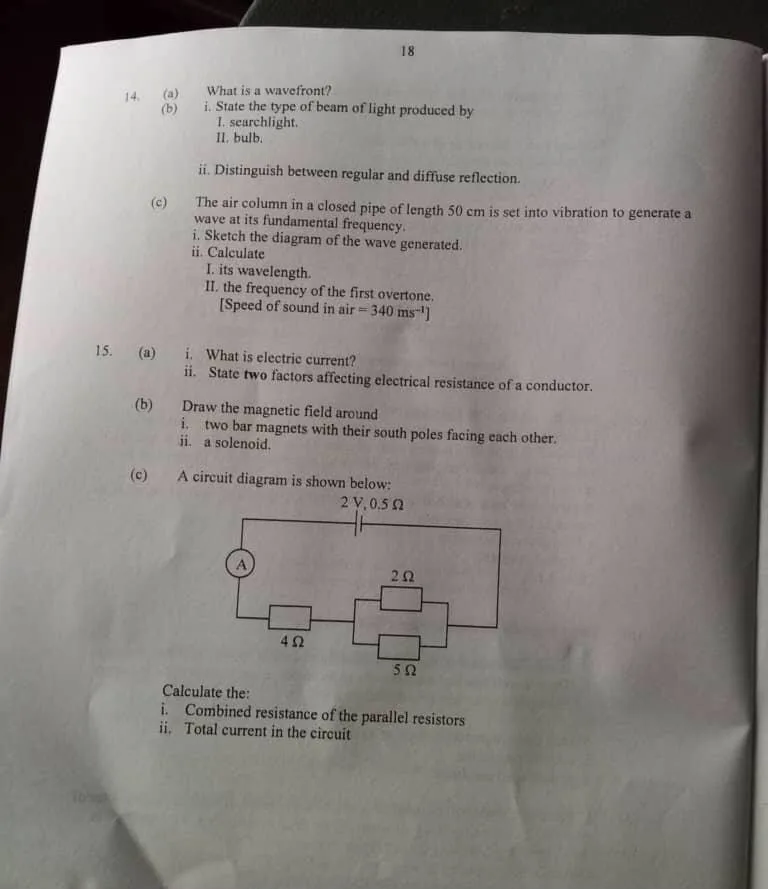
(14a)
A wavefront is an imaginary surface (or line) joining all points of a wave that are in the same phase of vibration at a given instant.
(14bi)
I: Searchlight produces a parallel beam of light (rays travel in straight lines parallel to one another).
II: Bulb (point source) produces a divergent beam of light (rays spread outward from a single point).
(14bii)
In regular reflection, parallel rays of light falling on a smooth, polished surface (e.g., a plane mirror) are reflected as parallel rays in one definite direction. WHILE In diffuse reflection, parallel rays falling on a rough surface are reflected in many different, scattered directions because the surface irregularities cause the normal at each point to point differently.
(14ci)
(DIAGRAM COMING)
(14cii)
I: Wavelength:
For a closed pipe at fundamental frequency: L = λ/4 → λ = 4L
λ = 4 × 0.50 m
λ = 2.0 m
(14cii)
II; Frequency of first overtone:
Fundamental frequency: f₁ = v/λ = 340/2.0 = 85 Hz:
f₁ = v/λ = 340 ms⁻¹ / 2.0 m = 170 Hz
For a closed pipe, only odd harmonics exist. The first overtone = 3rd harmonic = 3f₁
First overtone = 3 × 170
First overtone = 510 Hz
(15ai)
Electric current is the rate of flow of electric charge (electrons) through a conductor, measured in amperes.
(15aii)
(i)Length of the conductor (resistance increases with length)
(ii) Cross-sectional area of the conductor (resistance decreases as area increases)
(15bi)
(DIAGRAM COMING)
(15bii)
(DIAGRAM COMING)
(15ci)
Combined resistance of the parallel resistors (2Ω and 5Ω):
1/R = 1/2 + 1/5
1/R = 5/10 + 2/10 = 7/10
R(parallel) = 10/7 ≈ 1.43 Ω
(15cii)
Total current in the circuit:
Total resistance = internal resistance + series resistor + parallel combination
R(total) = 0.5 + 4 + 1.43
R(total) = 5.93 Ω
Using I = E/R(total):
I = 2/5.93
I ≈ 0.34 A
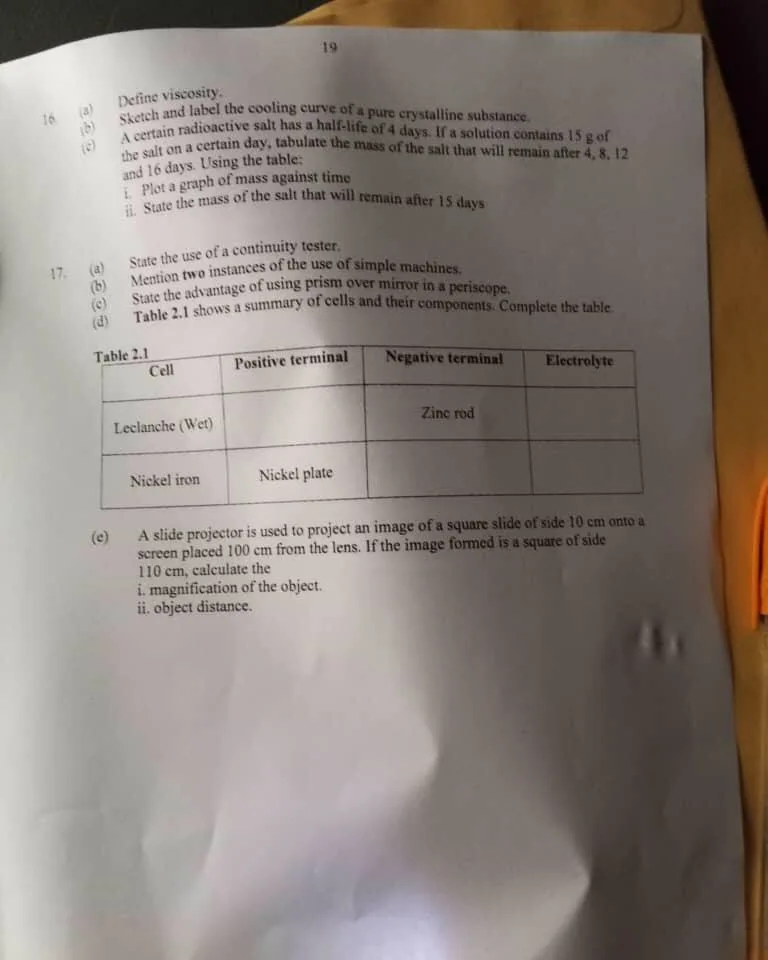
(17a)
A continuity tester is used to check whether an electrical circuit, wire, or component is complete (unbroken) it shows if current can flow through a conductor from one end to the other, helping detect breaks, cuts, or faults in wiring, fuses, or switches.
(17b)
(i) A wheelbarrow (lever) used to move goods on a construction site.
(ii)An inclined plane (ramp) used to load heavy goods/drums onto a truck.
(17c)
A prism uses total internal reflection, which reflects all the light falling on it with no loss of intensity and no silvering to wear off or tarnish, giving a brighter, clearer, single image a mirror, on the other hand, loses some light through absorption by its silvered coating and can produce faint multiple (ghost) images.
(17d)
PLS FILL THE TABLE BELOW USING OUR INSTRUCTIONS
UNDER; CELL
(i)Leclanché (Wet)
(ii)Nickel iron
UNDER; POSITIVE TERMINAL
(i)Carbon rod
(ii)Nickel plate
UNDER; NEGATIVE TERMINAL
(i)Zinc rod
(ii)Iron plate
UNDER; ELECTROLYTE
(i)Ammonium chloride solution
(ii)Potassium hydroxide solution
(17ei)
Magnification = Image size / Object size = 110 cm / 10 cm
Magnification, m = 11
(17eii)
Since m = v/u, and v (image distance) = 100 cm:
u = v/m = 100/11
Object distance, u ≈ 9.09 cm
This page is your live resource for the latest updates on the 2026 NECO Physics examination. Whether you’re preparing for the Objective (OBJ) paper or the Essay section, you’ll find verified information, expected topics, revision tips, and important announcements and the NECO 2026 Physics Expo.
Every year, thousands of candidates search for Physics exam updates before the paper. This page is updated regularly to provide accurate information and help you prepare effectively.
Latest Update: There are currently no verified NECO Physics Objective or Essay questions and answers available before the examination. This page will be updated with official information and post-exam discussions when available.
NECO Physics 2026 Examination Information
| Item | Details |
|---|---|
| Examination | NECO SSCE Internal 2026 |
| Subject | Physics |
| Paper | Objective (OBJ) & Essay |
| Examination Status | Awaiting Examination |
| Live Updates | Available |
| Questions Released? | No |
| Last Updated | June 2026 |
Are the NECO Physics Questions and Answers 2026/2027 Out?
No. As of the latest update, the official NECO Physics Objective and Essay questions have not been released before the examination.
Candidates should avoid relying on websites, Telegram channels, WhatsApp groups, or social media pages that claim to have the original examination questions before the paper. Most of these claims cannot be verified.
Keep checking this page for authentic updates throughout the examination period.
Important Topics to Revise
To increase your chances of success, pay special attention to these key topics:
- Measurements and Units
- Scalars and Vectors
- Motion
- Force and Equilibrium
- Work, Energy and Power
- Machines
- Density and Relative Density
- Pressure in Fluids
- Heat Energy
- Thermal Expansion
- Gas Laws
- Waves
- Sound
- Light and Reflection
- Refraction
- Lenses and Optical Instruments
- Electrostatics
- Current Electricity
- Electrical Circuits
- Magnetism
- Electromagnetic Induction
- Radioactivity
- Modern Physics
These topics are frequently assessed in both Objective and Essay sections of the examination.
How to Score High in NECO Physics
Use these practical tips during your preparation:
- Study the official NECO Physics syllabus.
- Memorize important formulas and SI units.
- Practice calculations daily.
- Solve previous NECO and WAEC Physics questions.
- Understand concepts instead of memorizing answers.
- Draw neat diagrams where required.
- Show complete workings for calculation questions.
- Manage your examination time wisely.
Common Formula Areas to Revise
Before the examination, ensure you understand formulas relating to:
| Topic | Formula Examples |
|---|---|
| Speed | Distance ÷ Time |
| Density | Mass ÷ Volume |
| Pressure | Force ÷ Area |
| Work | Force × Distance |
| Power | Work ÷ Time |
| Electrical Power | Voltage × Current |
| Ohm’s Law | Voltage = Current × Resistance |
Knowing when and how to apply these formulas is just as important as memorizing them.
Live Examination Updates
This page serves as a live update center for the NECO Physics examination.
Throughout the examination period, verified information such as timetable changes, official announcements, and post-exam discussions will be added here.
Bookmark this page and revisit it regularly for the latest updates.
READ ALSO: NECO Physics Formula Sheet and Calculation Guide 2026/2027
Frequently Asked Questions
Are the NECO Physics Objective and Essay Questions Out?
No. There are currently no verified questions or answers available before the examination.
Will This Page Be Updated?
Yes. We update this page regularly with verified examination information and post-exam discussions.
Is Physics Difficult?
Physics can be challenging if you rely solely on memorization. Understanding concepts, practicing calculations, and solving past questions consistently will greatly improve your performance.
How Can I Get an Excellent Grade in NECO Physics?
Study the syllabus thoroughly, practice numerical problems, revise formulas regularly, understand practical applications, and solve past examination questions under timed conditions.
Conclusion
Many candidates search for NECO Physics Questions and Answers 2026/2027 (Objective & Essay) every year. While staying informed is helpful, the most effective way to succeed is through consistent preparation and a solid understanding of the subject.
Study the official syllabus, revise important topics, practice calculations, and solve previous examination questions. These strategies will prepare you far better than relying on unverified information.
Keep visiting MasterNECO.com.ng for verified NECO examination updates, Physics revision guides, practical resources, past question analysis, and the latest education news throughout the 2026 examination season.







Leave a Comment