Are you searching for the NECO Agricultural Science Practical Questions and Answers 2026/2027? If yes, this page provides the latest updates, examination information, specimen guidance, and important revision tips for candidates preparing for the practical paper.
Every year, thousands of candidates search for Agricultural Science practical updates before entering the examination hall. This page serves as a live update centre for verified information before, during, and after the examination.
NECO Agricultural Science Practical 2026 Questions
NECO Agric Practical Answers 2026
INSTRUCTIONS : ANSWER ALL QUESTIONS
===================================================
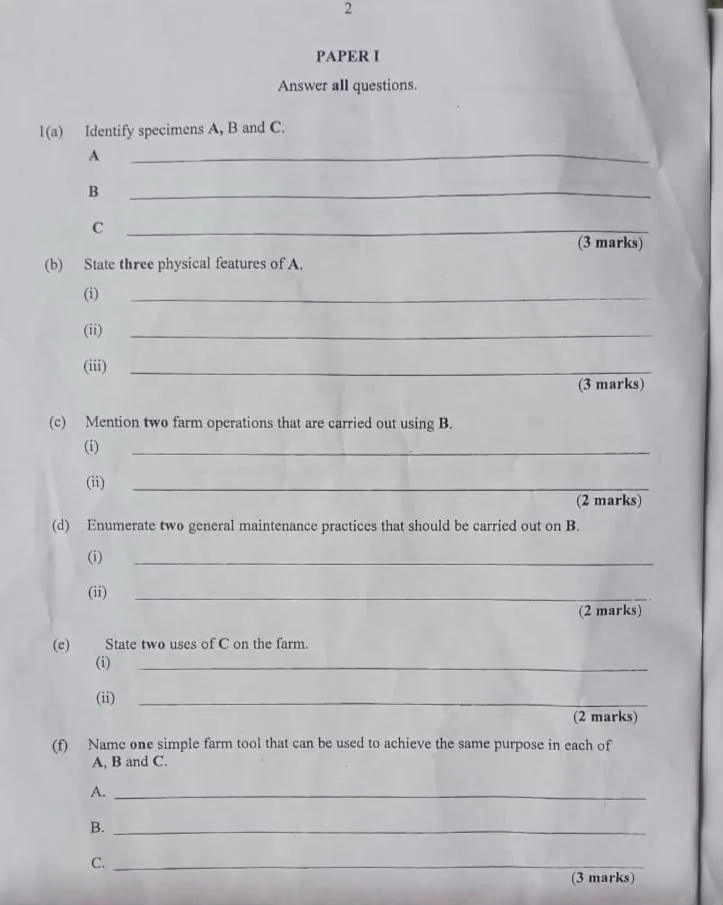
(1a)
A: Wheelbarrow
B: Garden fork
C: Shears
(1b)
(PICK ANY THREE)
(i) Has one wheel at the front.
(ii) Has two handles for pushing.
(iii) Has a large metal tray (bucket) for carrying loads.
(iv) Has two supporting legs.
(v) Has a strong metal frame.
(vi) The tray is deep and concave.
(vii) Has rubber grips on the handles.
(1c)
(PICK ANY TWO)
(i) Turning and loosening the soil.
(ii) Lifting and mixing manure or compost.
(iii) Uprooting root crops.
(iv) Breaking soil clods.
(v) Incorporating organic manure into the soil.
(vi) Aerating the soil.
(1d)
(PICK ANY TWO)
(i) Clean and dry it after use.
(ii) Oil the metal parts and store it in a dry place.
Extra:
(iii) Sharpen the prongs when blunt.
(iv) Tighten loose handle or fittings.
(v) Paint the metal parts to prevent rust.
(vi) Replace broken handles promptly.
(1e)
(PICK ANY TWO)
(i) Trimming hedges and live fences.
(ii) Pruning branches and shoots of plants.
(iii) Shaping ornamental plants.
(iv) Harvesting flowers.
(v) Cutting grasses and small shrubs.
(vi) Removing dead or diseased branches.
(1f)
A: Head pan
B: Hoe
C: Cutlass
===================================================
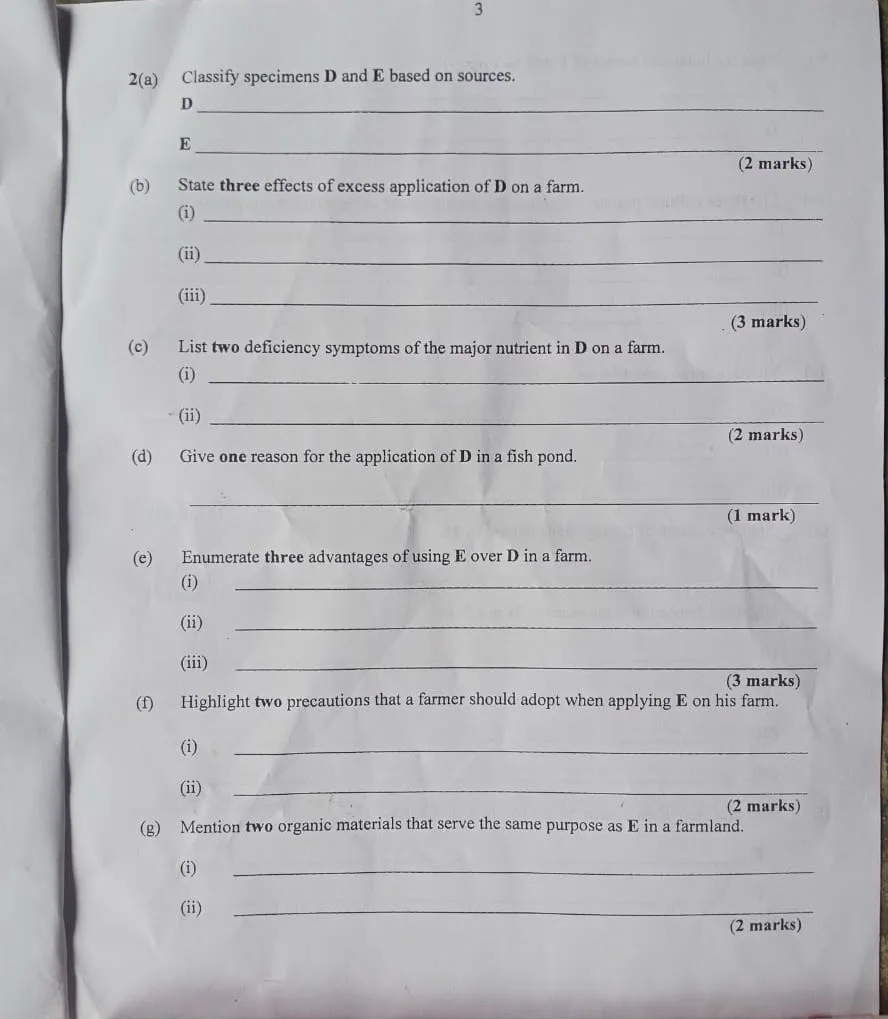
(2a)
D: Inorganic fertilizer
E: Organic fertilizer
(2b)
(PICK ANY THREE)
(i) Scorches or burns crop leaves and roots.
(ii) Causes excessive vegetative growth with poor yield.
(iii) Increases soil acidity.
(iv) Causes lodging of crops.
(v) Delays flowering and fruiting.
(vi) Leads to nutrient imbalance in the soil.
(vii) Pollutes nearby water bodies through leaching and runoff.
(2c)
(PICK ANY TWO)
(i) Yellowing (chlorosis) of older leaves.
(ii) Stunted or poor plant growth.
(iii) Reduced tillering in cereal crops.
(iv) Weak and slender stems.
(v) Premature leaf fall.
(vi) Low crop yield.
(2d)
(PICK ANY ONE)
(i) Promotes the growth of plankton which serves as fish food.
(ii) Increases the productivity of the pond.
(iii) Enhances fish growth rate.
(iv) Improves the nutrient content of pond water.
(v) Encourages the growth of microscopic aquatic organisms.
(2e)
(PICK ANY THREE)
(i) Adds organic matter (humus) to the soil.
(ii) Improves soil structure and water-holding capacity.
(iii) Releases nutrients slowly over a longer period.
(iv) Improves soil aeration.
(v) Encourages beneficial soil microorganisms.
(vi) Reduces the risk of fertilizer burn.
(vii) Is environmentally friendly and less polluting
(2f)
(i) Use well-decomposed cow dung.
(ii) Apply the correct quantity and incorporate it into the soil.
(2g)
(i) Compost manure.
(ii) Poultry droppings.
===================================================
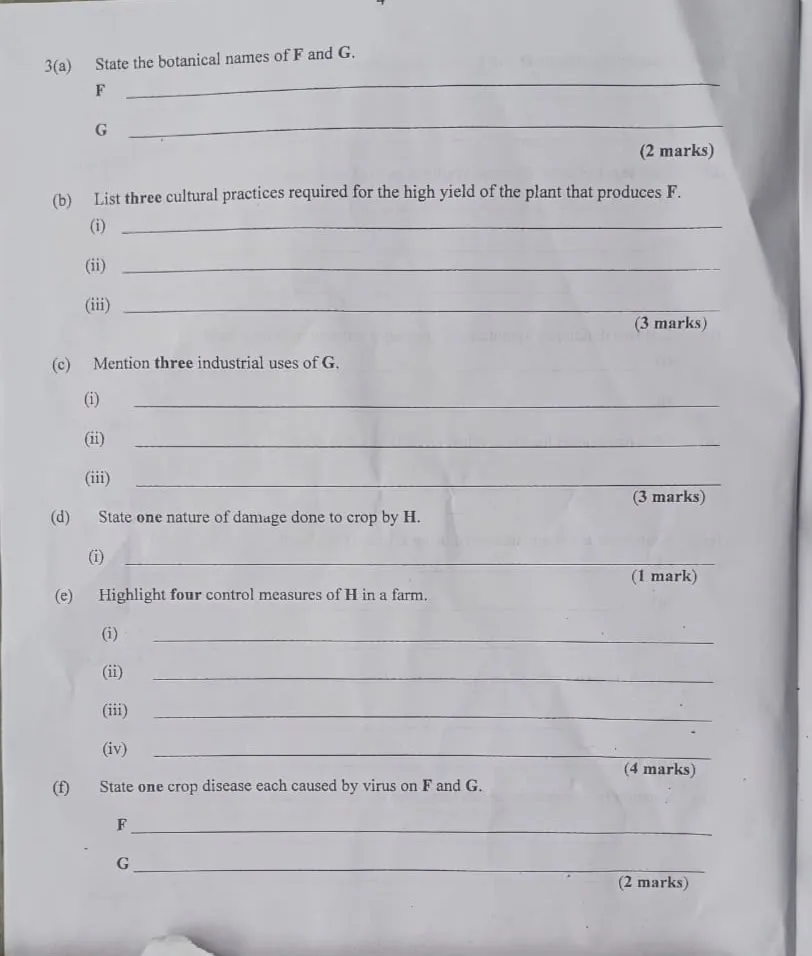
(3a)
F: Dioscorea rotundata
G: Arachis hypogaea
(3b)
(i) Weeding.
(ii) Staking.
(iii) Mulching.
(3c)
(PICK ANY THREE)
(i) Production of vegetable (groundnut) oil.
(ii) Manufacture of margarine.
(iii) Production of soap.
(iv) Production of peanut butter.
(v) Manufacture of livestock feed (groundnut cake).
(vi) Production of cosmetics.
(vii) Used in the confectionery and snack industry.
(3d)
(PICK ANY ONE)
(i) Gnaws and eats seeds, fruits and tubers.
(ii) Damages stems by gnawing them.
(iii) Destroys stored grains and other farm produce.
(iv) Contaminates crops with urine and droppings.
(v) Digs burrows that damage plant roots.
(3e)
(PICK ANY FOUR)
(i) Use of traps.
(ii) Apply rodenticides (rat poison).
(iii) Keep the farm and store clean.
(iv) Encourage natural predators such as cats.
(v) Destroy rat burrows and hiding places.
(vi) Store produce in rat-proof containers or stores.
(vii) Clear bushes and weeds around the farm.
(viii) Seal holes and openings in storage facilities.
(3f)
F: Yam mosaic disease.
G: Groundnut rosette disease.
===================================================
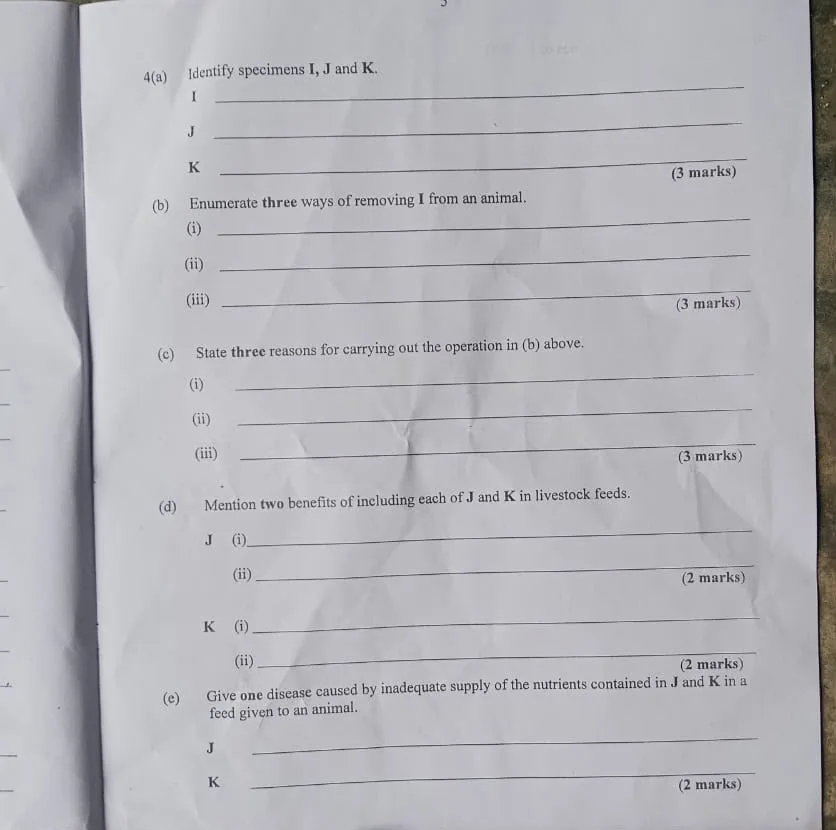
(4a)
I: Animal horn
J: Oyster shell
K: Maize cob
(4b)
(PICK ANY THREE)
(i) Dehorning with a dehorning saw.
(ii) Dehorning with a dehorning knife.
(iii) Dehorning with a hot iron (disbudding).
(iv) Using a scoop dehorner.
(v) Using a Barnes dehorner (dehorning clipper).
(vi) Applying caustic dehorning paste to young horn buds.
(vii) Using a wire saw.
(4c)
(PICK ANY THREE)
(i) To prevent injury to other animals.
(ii) To prevent injury to the farmer or handler.
(iii) To make handling and transportation easier.
(iv) To reduce fighting among animals.
(v) To save space in housing.
(vi) To prevent damage to farm equipment and facilities.
(vii) To minimize bruises and damage to carcasses or hides.
(4d)
J:
(PICK ANY TWO)
(i) Supplies calcium for strong bones and teeth.
(ii) Improves eggshell formation in laying birds.
(iii) Prevents calcium deficiency.
(iv) Enhances bone development in young animals.
(v) Supports muscle and nerve functions.
(vi) Improves growth and productivity.
K:
(PICK ANY TWO)
(i) Provides fibre (roughage) for proper digestion.
(ii) Promotes normal bowel movement and rumination in ruminants.
(iii) Prevents constipation.
(iv) Improves rumen function.
(v) Serves as a source of bulk in livestock feed.
(vi) Helps maintain digestive health.
(4e)
J:
(PICK ANY ONE)
(i) Rickets.
(ii) Osteomalacia.
(iii) Osteoporosis.
(iv) Eggshell thinning/soft-shelled eggs.
(v) Milk fever
K:
(PICK ANY ONE)
(i) Bloat.
(ii) Constipation.
(iii) Indigestion.
(iv) Acidosis.
(v) Ruminal impaction.
===================================================
NECO Agricultural Science Practical Examination Information
| Item | Details |
|---|---|
| Examination Body | NECO |
| Subject | Agricultural Science |
| Paper Type | Practical |
| Session | 2026/2027 |
| Examination Status | Scheduled |
| Live Updates | Available |
READ ALSO: NECO Agricultural Science Practical Specimen 2026/2027
Important Areas to Revise
Candidates should pay attention to:
- Identification of farm tools and equipment
- Functions of agricultural implements
- Crop specimens and identification
- Animal feed and feed ingredients
- Soil samples and soil types
- Farm records and bookkeeping
- Pests and diseases of crops
- Livestock management
- Agricultural practices
- Storage and preservation methods
Frequently Tested Specimen Areas
| Area | Importance |
|---|---|
| Farm Tools | Very High |
| Crop Specimens | Very High |
| Animal Feed Samples | High |
| Soil Samples | High |
| Farm Records | Medium |
| Livestock Materials | Medium |
Tips for Success in Agricultural Science Practical
- Study common specimens and their uses.
- Learn the functions of agricultural tools.
- Revise crop pests and diseases.
- Read all instructions carefully.
- Label specimens correctly.
- Write answers clearly and neatly.
Live Examination Updates
This page will be updated with verified announcements, examination information, and post-exam discussions whenever available.
Bookmark this page and revisit it regularly for updates.
Conclusion
Candidates searching for NECO Agricultural Science Practical Questions and Answers 2026/2027 should focus on understanding practical concepts and specimen identification rather than relying on unverified information.
Continue visiting MasterNECO.com.ng for revision guides, specimen updates, and examination resources throughout the 2026 NECO examination season.







Leave a Comment