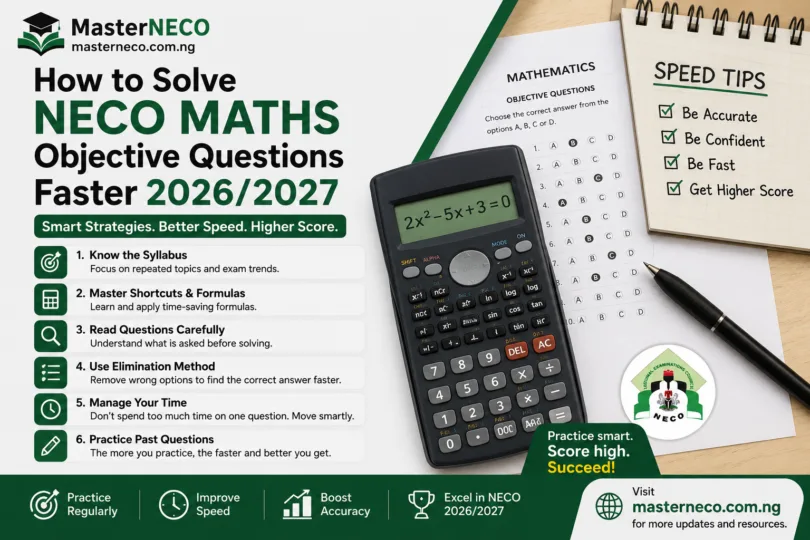
How to Solve NECO Maths Objective Questions Faster 2026/2027 (Proven Speed Techniques)
Mathematics is one of the most important subjects in the National Examinations Council (NECO) Senior School Certificate Examination (SSCE). For many students, the biggest challenge is not only understanding mathematical concepts but also answering a large number of objective questions within a limited time.
The NECO Mathematics objective examination tests students on different areas such as algebra, geometry, statistics, trigonometry, number bases, probability, mensuration, and everyday mathematics. Since candidates are required to answer many questions within a short period, speed and accuracy are essential skills.
Learning how to solve NECO Maths objective questions faster can significantly improve your examination performance. With the right preparation methods, shortcuts, time management skills, and problem-solving techniques, you can complete the exam confidently and reduce mistakes.
This guide explains the best strategies to help NECO candidates prepare effectively for the 2026/2027 examination session.
Understanding the NECO Mathematics Objective Examination
Before learning how to increase your speed, it is important to understand how the objective section works.
The NECO Mathematics objective paper contains multiple-choice questions designed to test your understanding of mathematical concepts. Each question usually has options from which you must select the correct answer.
A typical candidate needs to balance three things:
| Skill | Importance During NECO Maths Exam |
|---|---|
| Speed | Helps you attempt more questions before time runs out |
| Accuracy | Prevents losing marks through careless mistakes |
| Understanding | Helps you solve unfamiliar questions |
Many students spend too much time on one difficult question and eventually rush through easier questions. A good strategy is to answer simple questions quickly and return to challenging ones later.
1. Master the NECO Mathematics Syllabus
The fastest students in NECO Mathematics are usually not those who calculate the fastest but those who recognise question patterns quickly.
The NECO syllabus contains repeated topics and common question styles. Knowing the frequently tested areas allows you to identify what a question requires immediately.
Some major NECO Mathematics topics include:
| Topic | Common Question Areas |
|---|---|
| Algebra | Equations, inequalities, factorisation |
| Geometry | Angles, shapes, circles |
| Statistics | Mean, median, mode, charts |
| Trigonometry | Sine, cosine, tangent |
| Number Bases | Conversion and calculations |
| Probability | Chances and outcomes |
| Mensuration | Area, volume, perimeter |
When you understand these areas, you spend less time trying to figure out the method.
2. Practise With Past NECO Mathematics Questions
One of the most effective ways to solve NECO Maths objective questions faster is by practising previous examination questions.
Past questions help you:
- Understand the exam pattern
- Identify repeated concepts
- Improve calculation speed
- Learn common tricks used in questions
- Build confidence
Do not just solve past questions randomly. Study your mistakes and understand why your answer was wrong.
A useful practice method is:
- Pick a set of objective questions.
- Set a timer.
- Solve without checking answers.
- Mark your work.
- Review every mistake.
The more familiar you become with question styles, the faster your brain recognises solutions.
3. Learn Mathematical Shortcuts and Formulas
Memorising important formulas saves valuable examination time.
Instead of spending several minutes deriving formulas, you can immediately apply the correct method.
Some useful formulas include:
| Topic | Formula |
|---|---|
| Area of Rectangle | Length × Breadth |
| Area of Triangle | ½ × Base × Height |
| Simple Interest | P × R × T ÷ 100 |
| Speed | Distance ÷ Time |
| Mean | Sum of Values ÷ Number of Values |
Before the examination, create a personal formula revision list and practise using each formula repeatedly.
4. Improve Your Mental Calculation Skills
Many NECO Maths objective questions can be solved faster without writing every step.
For example, simple calculations involving:
- Addition
- Subtraction
- Multiplication
- Division
- Fractions
- Percentages
can often be completed mentally.
However, avoid rushing calculations that require accuracy. A small mistake can change your final answer.
Practice mental calculations daily by solving short mathematical problems without depending completely on a calculator.
5. Use the Elimination Method
When you are unsure about an answer, do not waste too much time guessing.
The elimination method helps you remove incorrect options and increase your chance of selecting the right answer.
For example:
If a question has four options and you can confidently remove two wrong answers, you have already improved your chances.
Look for:
- Impossible values
- Wrong units
- Incorrect signs
- Answers that do not fit the question
This method is especially useful for difficult objective questions.
6. Read Questions Carefully Before Solving
Some students lose marks because they misunderstand the question.
Common mistakes include:
- Solving for the wrong variable
- Missing negative signs
- Ignoring units
- Choosing the nearest answer without checking
A fast student is not someone who reads carelessly. Speed comes from understanding quickly.
Train yourself to identify:
- What information is given
- What you need to find
- Which formula applies
7. Start With Easier Questions
When the examination begins, avoid attacking the hardest questions first.
A better approach is:
- Answer questions you know immediately.
- Skip questions that require too much time.
- Return to difficult ones later.
This prevents wasting valuable minutes.
A simple time management plan:
| Exam Stage | Action |
|---|---|
| First few minutes | Scan questions and identify easy ones |
| Middle period | Solve moderate questions |
| Final minutes | Review difficult questions and check answers |
8. Practise Timed Mock Examinations
Speed is a skill that improves through practice.
Many students know mathematics but perform poorly because they have never practised under exam conditions.
During revision:
- Use a timer
- Sit in a quiet environment
- Avoid distractions
- Treat practice like the real examination
This trains your brain to work faster under pressure.
9. Avoid Common NECO Maths Objective Mistakes
Knowing what mistakes to avoid can improve your score.
Some common errors include:
| Mistake | Solution |
|---|---|
| Spending too long on one question | Move on and return later |
| Poor time management | Practise with timers |
| Forgetting formulas | Revise formulas regularly |
| Misreading questions | Read carefully |
| Careless calculations | Double-check answers |
Small improvements can make a major difference in your final result.
10. Use Approximation When Appropriate
Some objective questions do not require exact calculations.
Approximation can help you quickly identify the closest answer.
For example, if a calculation gives a value close to one option, you may not need to complete every decimal calculation.
However, only use approximation when you are confident it will not affect the answer.
11. Develop a Daily NECO Maths Practice Routine
Consistent practice is better than studying everything at the last minute.
A simple study plan:
| Day | Activity |
|---|---|
| Monday | Algebra practice |
| Tuesday | Geometry revision |
| Wednesday | Statistics and probability |
| Thursday | Past questions |
| Friday | Formula revision |
| Weekend | Full mock examination |
Regular practice improves both speed and confidence.
12. Prepare Your Mind and Body Before the Exam
Exam performance is affected by your overall preparation.
Before NECO Mathematics:
- Sleep properly
- Arrive early
- Carry required examination materials
- Stay calm
- Avoid unnecessary distractions
A focused mind solves problems faster.
Frequently Asked Questions (FAQs)
1. How can I solve NECO Maths objective questions faster?
You can solve NECO Maths objective questions faster by practising past questions, mastering formulas, improving calculation speed, using elimination methods, and managing your time properly during the exam.
2. What topics should I focus on for NECO Mathematics 2026/2027?
Focus on important areas such as algebra, geometry, statistics, trigonometry, probability, number bases, and mensuration because these topics commonly appear in examinations.
3. Is practising past questions enough to pass NECO Maths?
Past questions are very useful, but they should be combined with proper understanding of mathematical concepts. Understanding helps you solve new question variations.
4. How much time should I spend on each NECO Maths objective question?
Try not to spend too much time on a single question. Answer simple questions quickly and return to difficult ones after completing easier questions.
5. Can I use shortcuts during NECO Mathematics?
Yes, shortcuts such as mental calculations, formula knowledge, and elimination techniques can help you save time, but accuracy should always come first.
6. Why do students fail NECO Mathematics objective questions?
Many students struggle because of poor preparation, weak understanding of formulas, lack of practice, careless mistakes, and poor time management.
7. How many days should I practise before NECO Maths?
There is no fixed number of days, but regular practice over several weeks before the examination is more effective than last-minute studying.
8. What is the best way to prepare for NECO Mathematics?
The best preparation method is combining syllabus study, past question practice, formula revision, timed tests, and learning from mistakes.
READ ALSO: NECO Mathematics Topics to Focus on in 2026/2027 SSCE: Complete Study Guide
Conclusion
Learning how to solve NECO Maths objective questions faster 2026/2027 requires more than knowing mathematical formulas. It involves practising regularly, understanding question patterns, improving speed, avoiding common mistakes, and developing strong exam techniques.
With consistent preparation and the right approach, NECO Mathematics can become easier and less stressful. Start practising early, focus on important topics, and build the confidence needed to achieve a better result.







Leave a Comment