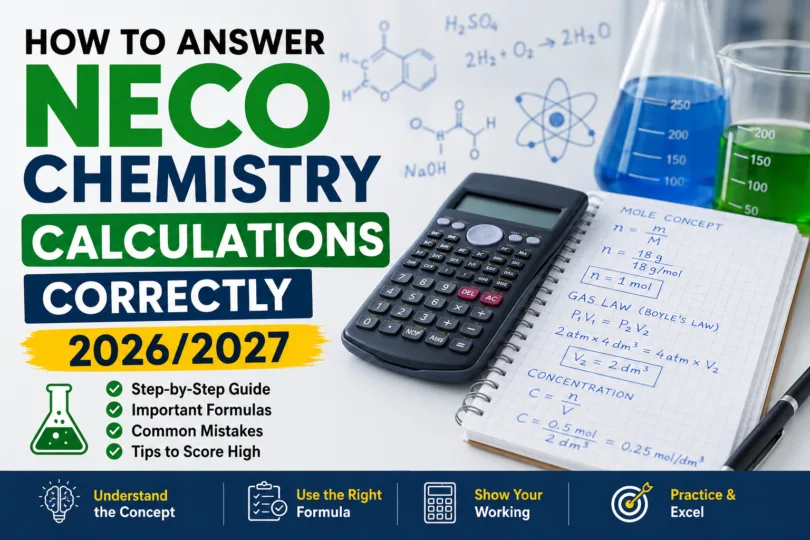
How to Answer NECO Chemistry Calculations Correctly. NECO Chemistry calculations are among the most challenging sections of the examination for many students. Unlike theory questions where you can explain concepts in words, calculation questions require accuracy, proper formulas, correct substitutions, and careful interpretation of data.
Many students lose marks in NECO Chemistry not because they do not understand the topic, but because they make simple mistakes such as using the wrong formula, failing to convert units, or skipping important steps. The good news is that with the right approach, you can solve Chemistry calculations faster and score higher in the 2026/2027 NECO SSCE examination.
This comprehensive guide explains how to answer NECO Chemistry calculations correctly, the common calculation topics to focus on, formulas you should know, mistakes to avoid, and practical strategies that will help you perform better.
Understanding NECO Chemistry Calculation Questions
NECO Chemistry calculations are designed to test your understanding of chemical principles and your ability to apply formulas. These questions usually appear in both objective and theory sections.
Common calculation areas include:
| Chemistry Calculation Topic | What Students Are Tested On |
|---|---|
| Mole Concept | Relationship between mass, moles and particles |
| Stoichiometry | Chemical equation calculations |
| Gas Laws | Pressure, volume and temperature relationships |
| Concentration | Molarity and solution preparation |
| Acids and Bases | pH and neutralisation calculations |
| Electrolysis | Faraday’s laws and electrode calculations |
| Percentage Composition | Chemical composition by mass |
| Empirical Formula | Finding simplest chemical formulas |
To perform well, students need more than memorising formulas. You must understand what each formula means and when to apply it.
Step 1: Read the Question Carefully
The first step to solving NECO Chemistry calculations correctly is understanding what the question is asking.
Many students rush into calculations immediately after seeing numbers. This often leads to wrong answers.
Before calculating, identify:
- What information is given?
- What quantity are you required to find?
- Which Chemistry topic is involved?
- Which formula applies?
For example:
“Calculate the number of moles in 18g of water.”
Given:
- Mass = 18g
- Substance = H₂O
- Required = Number of moles
Formula:
Number of moles = Mass / Molar mass
Molar mass of H₂O = 18g/mol
Therefore:
Moles = 18/18 = 1 mole
The answer becomes easy once you identify the required steps.
Step 2: Write Down the Correct Formula
NECO examiners reward students who show their working. Even if your final answer is wrong due to calculation errors, correct steps may earn you partial marks.
Always write the formula before substituting values.
Some important formulas include:
| Quantity | Formula |
|---|---|
| Number of moles | Mass ÷ Molar mass |
| Concentration | Mole ÷ Volume |
| Density | Mass ÷ Volume |
| Percentage yield | Actual yield ÷ Theoretical yield × 100 |
| Molarity | Moles ÷ Volume in dm³ |
| Gas volume at STP | 1 mole = 22.4 dm³ |
Writing the formula reduces mistakes and makes your solution easier to follow.
Step 3: Convert Units Correctly
Unit conversion is one of the biggest reasons students lose marks in Chemistry calculations.
Common conversions include:
| Conversion | Rule |
|---|---|
| cm³ to dm³ | Divide by 1000 |
| dm³ to cm³ | Multiply by 1000 |
| mg to g | Divide by 1000 |
| g to kg | Divide by 1000 |
Example:
Convert 250 cm³ to dm³.
250 ÷ 1000 = 0.25 dm³
If you forget this conversion when calculating concentration, your final answer will be incorrect.
Step 4: Balance Chemical Equations Before Calculations
Stoichiometry questions depend on balanced equations.
Example:
Hydrogen reacts with oxygen to form water.
Unbalanced:
H₂ + O₂ → H₂O
Balanced:
2H₂ + O₂ → 2H₂O
The ratio is:
2 : 1 : 2
This ratio is used in mole calculations.
Never calculate from an unbalanced equation.
Step 5: Master Mole Concept Calculations
The mole concept is the foundation of most NECO Chemistry calculations.
The main relationship is:
Moles = Mass / Molar Mass
Example:
Calculate the number of moles in 44g of carbon dioxide.
Molar mass of CO₂:
Carbon = 12
Oxygen = 16 × 2 = 32
Total = 44g/mol
Moles = 44/44
Answer = 1 mole
Students who understand mole calculations can easily solve many other Chemistry problems.
Step 6: Learn How to Solve Stoichiometry Questions
Stoichiometry involves using chemical equations to calculate quantities of reactants and products.
Example:
Calculate the mass of water produced when 2 moles of hydrogen react completely with oxygen.
Equation:
2H₂ + O₂ → 2H₂O
From the equation:
2 moles of hydrogen produce 2 moles of water.
Therefore:
2 moles H₂ = 2 moles H₂O
Molar mass of water = 18g/mol
Mass = moles × molar mass
Mass = 2 × 18
Answer = 36g
Step 7: Understand Concentration Calculations
Concentration questions are common in NECO Chemistry, especially during practical and theory papers.
Formula:
Concentration = Moles / Volume
Remember:
Volume must be in dm³.
Example:
A solution contains 0.5 moles in 2 dm³. Find the concentration.
Concentration = 0.5 / 2
= 0.25 mol/dm³
Step 8: Practice Gas Law Calculations
Gas laws are another important calculation area.
Common laws include:
- Boyle’s Law
- Charles’ Law
- Combined Gas Law
Boyle’s Law
Formula:
P₁V₁ = P₂V₂
Where:
P = Pressure
V = Volume
Example:
A gas occupies 4dm³ at 2 atm pressure. What volume will it occupy at 4 atm?
2 × 4 = 4 × V
8 = 4V
V = 2dm³
Step 9: Learn Acid and Base Calculations
Acid-base calculations usually involve pH, neutralisation and titration.
Important formula:
pH = -log[H⁺]
For beginners, focus on understanding:
- Strong acids
- Strong bases
- Neutralisation reactions
Example:
HCl + NaOH → NaCl + H₂O
The acid reacts with the base in a 1:1 ratio.
Step 10: Use Past NECO Questions for Practice
One of the fastest ways to improve is by practising previous NECO Chemistry questions.
Past questions help you:
- Understand question patterns
- Identify repeated topics
- Improve speed
- Reduce exam anxiety
Create a study plan where you solve different calculation questions every day.
Common Mistakes Students Make in NECO Chemistry Calculations
Avoid these errors:
| Mistake | Solution |
|---|---|
| Using wrong formula | Understand the topic first |
| Forgetting unit conversion | Check units before calculating |
| Not balancing equations | Balance chemical reactions first |
| Skipping steps | Show your working |
| Wrong molar masses | Memorise common atomic masses |
| Rushing answers | Read questions carefully |
NECO Chemistry Atomic Masses You Should Know
Some commonly used values:
| Element | Symbol | Atomic Mass |
|---|---|---|
| Hydrogen | H | 1 |
| Carbon | C | 12 |
| Oxygen | O | 16 |
| Nitrogen | N | 14 |
| Sodium | Na | 23 |
| Chlorine | Cl | 35.5 |
| Calcium | Ca | 40 |
| Sulphur | S | 32 |
Knowing these values saves time during examinations.
How to Improve Your Speed During NECO Chemistry Calculations
Time management is important because Chemistry contains both theory and calculations.
Follow these tips:
- Solve easier calculations first.
- Do not spend too long on one question.
- Write formulas immediately.
- Estimate your answer before calculating.
- Review your units.
A student who practises regularly can complete calculation sections faster.
Recommended Study Strategy for NECO Chemistry 2026/2027
A good preparation plan may look like this:
| Period | Activity |
|---|---|
| First Month | Learn formulas and concepts |
| Second Month | Practise topic-by-topic questions |
| Third Month | Solve complete past papers |
| Final Weeks | Revise formulas and weak areas |
Consistency is more effective than studying only a few days before the exam.
Final Tips for Getting High Marks in NECO Chemistry Calculations
To answer NECO Chemistry calculations correctly:
- Understand the question before solving
- Identify the correct formula
- Balance equations
- Convert units properly
- Show every step
- Practise frequently
- Review mistakes
Chemistry calculations become easier when you understand the logic behind the formulas instead of memorising blindly.
With proper preparation and regular practice, you can confidently handle NECO Chemistry calculations and improve your overall SSCE performance.
READ ALSO: NECO Syllabus for Chemistry 2026/2027 PDF Download For Free
Frequently Asked Questions (FAQs)
1. What are the most common NECO Chemistry calculation topics?
The most common topics include mole concept, stoichiometry, concentration, gas laws, acids and bases, electrolysis, and empirical formulas.
2. How can I pass NECO Chemistry calculations?
You can improve by practising past questions, learning formulas, balancing equations correctly, and understanding chemical concepts.
3. Do I need to memorise Chemistry formulas for NECO?
Yes. Knowing important formulas helps you solve questions faster, but you should also understand when to apply each formula.
4. Why do students fail Chemistry calculations?
Many students fail because of poor understanding of concepts, wrong formulas, unit conversion mistakes, and lack of practice.
5. Are NECO Chemistry calculation questions repeated?
Some concepts and question patterns may appear repeatedly, but students should prepare across all topics.
6. Can I use a calculator during NECO Chemistry?
Calculator rules depend on the current NECO examination guidelines. Candidates should follow the official instructions provided by their examination centre.
7. How many hours should I study Chemistry daily?
The ideal study time depends on your schedule, but regular daily practice is usually more effective than irregular long sessions.
8. What is the best way to prepare for NECO Chemistry 2026/2027?
Combine textbooks, class notes, past questions, and regular calculation practice to build confidence before the examination.







Leave a Comment