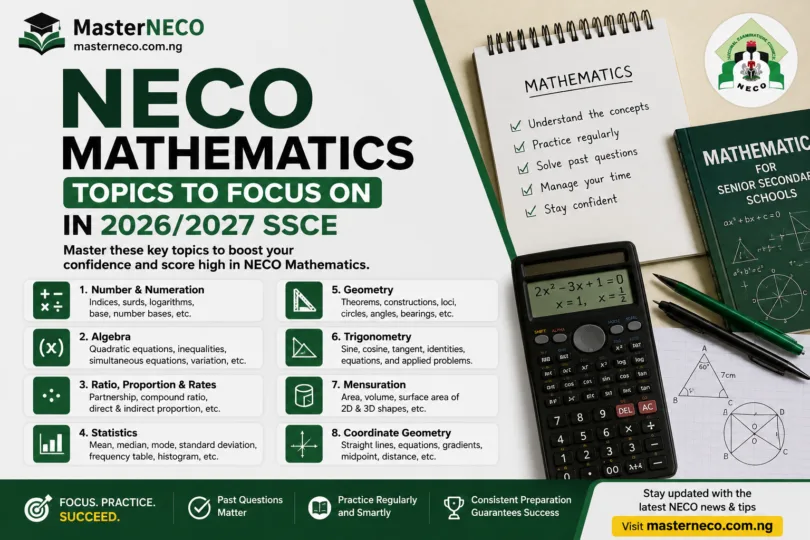
This guide breaks down the essential NECO Mathematics topics for the 2026/2027 examination cycle, providing insights into topic distribution, difficulty levels, and practical study strategies that work for Nigerian students.
Preparing for the NECO Senior Secondary Certificate Examination (SSCE) requires a strategic approach, especially in Mathematics. With the examination becoming increasingly competitive, understanding which topics carry the most weight and appear most frequently can significantly improve your performance and chances of securing a high grade.
The Mathematics curriculum for NECO SSCE spans multiple topics across algebra, geometry, statistics, and trigonometry. However, not all topics receive equal emphasis in the examination. By focusing your revision efforts on the most frequently tested and highest-value topics, you can maximize your study time and boost your score efficiently.
Understanding NECO Mathematics Examination Structure
Before diving into specific topics, it helps to understand how the NECO Mathematics examination is organized. The SSCE Mathematics paper typically consists of two sections: Paper 1 (Objectives/Multiple Choice) and Paper 2 (Essay/Theory). Understanding this structure helps you allocate your study time appropriately.
The examination tests both computational skills and conceptual understanding. Topics are not examined in isolation but often require knowledge from foundational areas. For example, solving quadratic equations might involve algebraic manipulation, graph plotting, and sometimes trigonometric concepts.
Success in NECO Mathematics depends on three things: understanding fundamental concepts, regular practice with past questions, and strategic topic prioritization. This article focuses on the third element by identifying which topics deserve your primary attention.
Core NECO Mathematics Topics for 2026/2027
1. Algebra and Equations
Algebra forms the backbone of the NECO Mathematics curriculum. This topic appears in nearly every examination and serves as a foundation for more advanced topics.
Key areas to focus on:
Number bases and conversion represent a fundamental concept that appears regularly. Students must understand how to convert numbers between base 10, base 2, and other bases. This topic tests conceptual understanding and computational accuracy simultaneously.
Polynomials and quadratic equations appear in multiple forms across the examination. You need to master factorization, completing the square, and the quadratic formula. Past questions show that approximately 8-12% of total marks come from this area.
Linear equations and simultaneous equations require both graphical and algebraic solutions. The examination often combines this topic with coordinate geometry, making it essential to understand both visual and algebraic representations.
Indices and surds test your ability to manipulate expressions with exponents and roots. These concepts frequently appear in Paper 1 and often combine with other topics in Paper 2.
Algebra Study Table:
| Topic | Frequency in Exams | Difficulty Level | Study Priority | Est. Time (hours) |
|---|---|---|---|---|
| Number Bases | High (8-10%) | Moderate | Very High | 8-10 |
| Quadratic Equations | Very High (10-12%) | Moderate to High | Very High | 12-15 |
| Simultaneous Linear Equations | High (7-9%) | Moderate | High | 8-10 |
| Indices and Surds | High (6-8%) | Moderate | High | 7-9 |
| Polynomials | Moderate (5-7%) | Moderate to High | Moderate | 6-8 |
2. Functions and Relations
Functions represent an increasingly important topic in recent NECO examinations. The examination board places significant emphasis on understanding function notation, domain, range, and composite functions.
Function evaluation and composition appear regularly and require clear understanding of substitution and algebraic manipulation. Inverse functions also feature prominently, particularly in Paper 2.
Graphs of functions test both your ability to sketch various function types and interpret given graphs. Common functions tested include linear, quadratic, cubic, reciprocal, and occasionally exponential functions.
Real-world applications of functions appear frequently, especially in Paper 2. These questions test conceptual understanding rather than pure computation. Topics like depreciation, compound interest, and population growth use exponential and logarithmic functions.
Functions and Relations Study Table:
| Topic | Exam Frequency | Required Skills | Common Question Types |
|---|---|---|---|
| Function Notation and Evaluation | High | Substitution, algebraic manipulation | Objective and essay |
| Composite Functions | High | Function composition, substitution | Essay/theory questions |
| Inverse Functions | Moderate to High | Algebraic rearrangement, domain analysis | Essay questions |
| Graphs of Functions | Very High | Sketching, interpretation, transformation | Both sections |
| Applied Functions | Moderate | Problem-solving, real-world interpretation | Essay questions |
3. Geometry and Trigonometry
Geometry constitutes a substantial portion of the NECO Mathematics curriculum. This section combines pure geometry with trigonometric concepts and often requires both visual understanding and computational skills.
Circle theorems and properties appear consistently in examinations. Students must understand angle properties, tangent-chord angles, and arc relationships. This topic frequently appears in Paper 2 requiring detailed proofs and logical reasoning.
Trigonometry covers sine, cosine, tangent functions across all quadrants. The examination tests angle calculations, trigonometric identities, and applications to real problems. Bearings and navigation problems represent a common application area that appears in most examination sessions.
Coordinate geometry combines algebraic and geometric thinking. Distance formula, midpoint calculations, gradient of lines, and equation of line in various forms must be mastered. This often combines with trigonometry when calculating angles between lines.
3D geometry and mensuration test your ability to work with volumes and surface areas of solids. Pyramids, cones, spheres, and composite solids appear regularly.
Geometry and Trigonometry Study Table:
| Topic | Exam Frequency | Difficulty | Paper Distribution | Study Hours |
|---|---|---|---|---|
| Circle Theorems | High (8-10%) | Moderate to High | Mainly Paper 2 | 10-12 |
| Trigonometric Ratios and Identities | Very High (10-14%) | Moderate to High | Both papers | 15-18 |
| Coordinate Geometry | High (8-11%) | Moderate | Both papers | 10-12 |
| Bearings and Navigation | Moderate (5-7%) | Moderate | Paper 2 | 6-8 |
| Mensuration (Volume and Area) | High (8-10%) | Moderate | Both papers | 10-12 |
| 3D Geometry | Moderate (4-6%) | High | Paper 2 | 6-8 |
4. Calculus Concepts
Calculus appears prominently in recent NECO examinations. While the curriculum focuses on basic calculus rather than advanced calculus, understanding differentiation and integration is essential for achieving high scores.
Differentiation from first principles represents a fundamental concept. Students must understand the limit definition and be able to apply it to simple functions. However, differentiation rules make problem-solving faster and more efficient.
Applications of differentiation include finding maximum and minimum values, determining rates of change, and optimization problems. These practical applications appear frequently in Paper 2.
Integration or anti-differentiation tests your ability to reverse the differentiation process. Definite and indefinite integrals both appear, with applications in finding areas under curves.
Calculus Study Table:
| Topic | Frequency | Difficulty | Typical Mark Value | Study Focus |
|---|---|---|---|---|
| Differentiation from First Principles | Moderate | High | 5-8 marks | Understanding, not just application |
| Differentiation Rules and Applications | High | Moderate | 8-12 marks | Speed and accuracy |
| Maximum and Minimum Problems | High | Moderate to High | 5-10 marks | Problem-solving approach |
| Integration and Anti-derivatives | Moderate to High | Moderate to High | 8-12 marks | Practice with multiple methods |
| Applications of Integration | Moderate | High | 5-8 marks | Conceptual understanding |
5. Statistics and Probability
Statistics and probability represent increasingly important topics in modern examinations. These topics test both computational skills and data interpretation abilities.
Data collection and representation cover frequency distributions, histograms, cumulative frequency curves, and various graphical representations. Students must understand when to use different representations.
Measures of central tendency and dispersion require calculating mean, median, mode, range, variance, and standard deviation. Understanding the differences between these measures and when each is appropriate is critical.
Probability concepts test understanding of basic probability rules, conditional probability, and independence. Tree diagrams and sample space representations frequently appear.
Correlation and regression appear in recent papers. Students need to draw scatter diagrams, calculate correlation coefficients, and understand the relationship between correlation and causation.
Statistics and Probability Study Table:
| Topic | Test Frequency | Skill Type | Common Errors | Time Needed |
|---|---|---|---|---|
| Frequency Distributions | High | Data organization | Grouping errors | 8-10 hours |
| Mean, Median, Mode | Very High | Calculation | Confusion in grouped data | 6-8 hours |
| Standard Deviation | High | Calculation | Formula confusion | 8-10 hours |
| Probability Basics | High | Conceptual | Overlapping events | 8-10 hours |
| Conditional Probability | Moderate | Conceptual | Misunderstanding conditions | 6-8 hours |
| Correlation and Regression | Moderate | Analysis | Interpretation errors | 8-10 hours |
Study Strategy for 2026/2027 Preparation
Effective NECO Mathematics preparation requires structured planning. The following strategy maximizes your learning outcomes over a typical 6-month preparation period.
Months 1-2: Foundation Building
During the first two months, focus on algebra and number bases. These form the foundation for other topics. Ensure you can solve equations fluently and convert between number bases without hesitation. Practice computational accuracy through daily problem sets.
Complete at least 50 past questions focusing on Paper 1 (objectives) from these topics. Accuracy matters more than speed at this stage.
Months 3-4: Core Topic Development
Dedicate these months to functions, coordinate geometry, and statistics. These topics combine computational and conceptual skills. Practice both objective and essay questions. By end of Month 4, you should be comfortable with 70-80% of questions from these areas.
Begin attempting full past papers during Month 4, focusing on time management. Allocate specific time per question and practice completing papers within the examination timeframe.
Months 5-6: Advanced Topics and Consolidation
Focus on calculus applications, trigonometric identities, and circle theorems. These require deeper conceptual understanding. Practice explaining solutions in writing for essay questions.
Complete at least 6 full past papers from 2020-2025. Analyze your performance, identifying weak areas. Allocate final study time to improving these specific areas rather than general revision.
Study Strategy Table:
| Period | Primary Topics | Secondary Topics | Target Accuracy | Activity Focus |
|---|---|---|---|---|
| Month 1-2 | Algebra, Number Bases | Indices, Surds | 65-75% | Foundation, daily practice |
| Month 3-4 | Functions, Coordinate Geometry | Statistics | 70-80% | Mixed questions, full papers |
| Month 5-6 | Calculus, Trigonometry | Circle Theorems | 75-85% | Past papers, weak area revision |
Common Mistakes Students Make in NECO Mathematics
Understanding common errors helps you avoid making the same mistakes. These patterns emerge consistently across multiple examination years.
- Careless computational errors remain the most frequent source of lost marks. Students understand concepts but make arithmetic mistakes. Prevention requires careful working and checking answers using alternative methods.
- Misreading questions causes students to solve the wrong problem. Always read questions completely before starting your solution. Identify what the question asks, not what you expect it to ask.
- Incomplete solutions in Paper 2 lose marks unnecessarily. Always show your working, even when confident. Examination markers award partial credit for correct working even when the final answer is wrong.
- Confusion between similar concepts particularly affects topics like correlation versus causation, and conditional versus independent probability. Create comparison tables distinguishing these concepts.
- Poor graph sketching leads to lost marks in coordinate geometry and calculus. Practice sketching graphs quickly and accurately. Label axes, indicate key points, and show asymptotes where relevant.
- Neglecting to verify answers means missing errors. For objective questions, substitute your answer back into the original equation. For essay questions, check whether your answer makes sense in context.
Resources for NECO Mathematics Preparation
Several resource types support effective NECO Mathematics preparation:
- Past examination papers represent your most valuable resource. These show actual question patterns, difficulty levels, and mark distributions. Complete at least 10 papers before the examination.
- Study guides and textbooks like the WAEC/NECO-aligned mathematics texts provide comprehensive topic coverage. Select guides designed specifically for NECO SSCE rather than generic mathematics textbooks.
- Online video tutorials help explain difficult concepts visually. Platforms offering NECO-specific content provide examples and solutions using the actual curriculum.
- Practice question banks allow targeted practice on specific topics. Quality matters more than quantity; solving 20 challenging questions teaches more than solving 200 similar easy questions.
- Study groups with classmates improve learning through discussion and explanation. Teaching concepts to others reveals gaps in your understanding.
- Mathematics tutors provide personalized feedback and can address your specific weak areas. Consider tutoring for topics where self-study hasn’t been effective.
Topic Importance and Distribution for 2026/2027
Based on recent examination patterns, the following table shows predicted topic emphasis for 2026/2027:
Predicted Topic Emphasis Table:
| Topic | Estimated Percentage of Total Marks | Likelihood in Paper 1 | Likelihood in Paper 2 | Importance Ranking |
|---|---|---|---|---|
| Algebra and Equations | 12-15% | Very High | High | 1 |
| Functions and Relations | 10-12% | High | High | 2 |
| Trigonometry | 10-14% | Moderate | Very High | 2 |
| Coordinate Geometry | 8-10% | Moderate | High | 3 |
| Circle Theorems | 8-10% | Low | High | 3 |
| Calculus | 8-10% | Low | High | 4 |
| Statistics and Probability | 10-12% | High | High | 3 |
| Mensuration | 8-10% | Moderate | High | 4 |
| Number Bases | 6-8% | Very High | Low | 4 |
| Applied Problems | 6-8% | Low | Moderate | 3 |
Frequently Asked Questions About NECO Mathematics
Q: Which topics have the highest failure rates in NECO Mathematics?
A: Statistics show that circle theorems, calculus applications, and 3D geometry consistently challenge students. These topics combine abstract thinking with practical application, requiring both conceptual understanding and problem-solving skills. Students often focus too late on these topics or attempt them without solid foundations in coordinate geometry and trigonometry. Success requires early introduction to these topics with adequate practice time.
Q: How many hours should I dedicate to NECO Mathematics preparation?
A: Most successful students allocate 120-180 hours to comprehensive NECO Mathematics preparation over a 6-month period. This breaks down to 20-30 hours per month, or about 5-7 hours per week. However, quality matters more than quantity. Focused study for 3 hours with full concentration beats 8 hours of unfocused revision. Adjust your study hours based on your current competence level; students starting from weak foundations need more time than those with solid bases.
Q: Should I use a calculator for NECO Mathematics?
A: The NECO Mathematics examination permits scientific calculators in Paper 2 (essay) but not in Paper 1 (objectives). However, relying excessively on calculators weakens mental arithmetic skills and calculation accuracy. Practice calculations by hand during preparation, using calculators only to verify answers or for complex computations. This approach ensures you can solve problems quickly even if calculator functions fail during the examination.
Q: How do past papers help NECO Mathematics preparation?
A: Past papers provide three key benefits. First, they reveal the question format, difficulty level, and typical mark distribution. Second, they help you practice time management under examination conditions. Third, they identify topic areas where questions appear more frequently. Analysis of 5-10 years of past papers shows clear patterns in which topics appear most often, helping you prioritize your revision effectively.
Q: What’s the difference between NECO and WAEC Mathematics?
A: While both curricula cover similar topics, NECO and WAEC differ in emphasis and question style. NECO papers tend to emphasize practical applications and problem-solving more than WAEC. NECO paper 2 often includes more extended response questions requiring detailed explanations. However, both examinations test fundamentally similar mathematics, so students preparing for either examination benefit from understanding both question styles.
Q: How can I improve my score from 50% to 70%?
A: Improvement from moderate to high performance requires addressing specific weak areas rather than general revision. Identify which topics you understand but solve incorrectly due to careless errors versus topics where conceptual understanding is lacking. For careless error topics, practice accuracy through repeated solving and checking. For conceptual gaps, return to basics and build understanding through worked examples before attempting questions. The final 20 percentage points require precision and deep understanding rather than broad coverage.
Q: What should I do with topics I find extremely difficult?
A: Don’t avoid difficult topics. Instead, break them into smaller components and build understanding gradually. For example, circle theorems seem overwhelming as a whole topic, but individual theorems are manageable. Master one theorem at a time, practice related questions, then move to the next. Once you understand all individual theorems, tackle theorem combination questions where multiple theorems apply. This incremental approach builds confidence while ensuring thorough understanding.
Q: How important is showing working in NECO Mathematics Paper 2?
A: Showing working is critical. Paper 2 awards marks for method and reasoning, not just correct answers. A well-explained solution earning 70% of available marks for that question beats a correct answer without explanation. Even when your final answer is wrong, correct working earns substantial partial credit. Always write clearly enough that another person can follow your reasoning, using proper mathematical notation and explaining your steps.
Q: Can I pass NECO Mathematics by memorizing formulas?
A: No. While knowing formulas is necessary, success requires understanding when and how to apply them. Examination questions frequently require formula derivation or application in non-standard situations. Students who memorize without understanding cannot adapt when questions differ slightly from examples they’ve practiced. Memorization supports true learning but cannot replace conceptual understanding.
Q: Should I attempt all questions or focus on questions I can solve?
A: Strategy depends on your target grade. For high grades (A-B), attempt every question but allocate more time to familiar topics where you solve questions correctly. For moderate grades (C-D), focus first on questions you can definitely answer, ensuring you accumulate marks through correct solutions. Attempting questions where you’re uncertain wastes time that could earn marks elsewhere. However, in Paper 1, attempt all objective questions since there’s no penalty for wrong answers; educated guessing can score marks.
Q: What’s the best way to prepare during the final week before NECO Mathematics?
A: Final week preparation should focus on consolidation, not learning new topics. Review formulas, revisit challenging question types, and practice time management with past papers. Ensure you rest adequately; fatigue during the examination costs more marks than last-minute studying gains. Review your notes on common mistakes and weak areas identified during preparation. Minimize anxiety through routine, adequate sleep, and confidence-building activities like solving familiar question types.
Conclusion
Success in NECO Mathematics 2026/2027 requires strategic focus on high-value topics combined with consistent, quality practice. The topics outlined in this guide represent your roadmap to high performance. Begin your preparation now, allocate study time proportionally to topic importance and your personal weak areas, and commit to regular practice with past examination questions.
Remember that mathematics is a skill developed through practice, not memorization. Each question you solve, particularly questions you initially find difficult, strengthens your understanding and problem-solving ability. Approach your NECO Mathematics preparation with systematic planning, maintain consistency through the preparation period, and focus your final efforts on areas where you need most improvement.
The examination rewards students who understand foundational concepts thoroughly and can apply these concepts in unfamiliar situations. Your preparation should emphasize conceptual understanding over memorization, practice solving problems from multiple angles, and build the confidence necessary to perform well under examination conditions. With focused effort and strategic preparation using the topics and strategies outlined here, achieving your target grade in NECO Mathematics is entirely within your reach.







GOOD