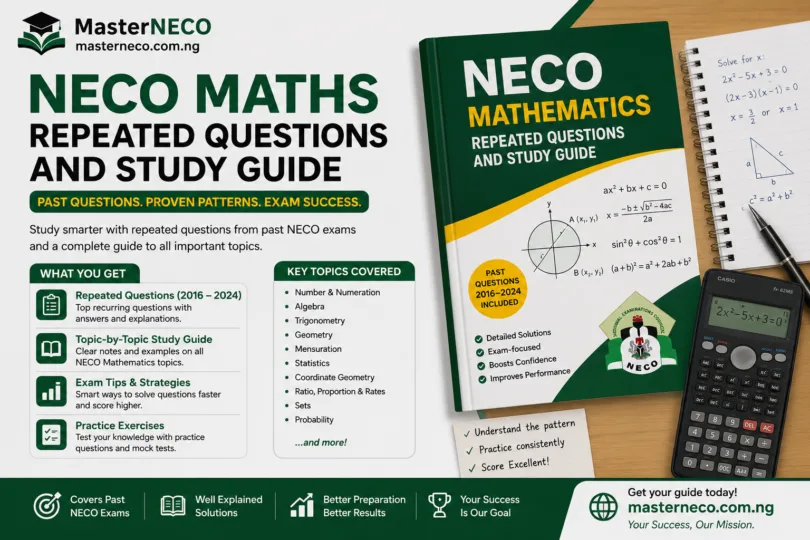
The National Examination Council (NECO) Senior Secondary Certificate Examination (SSCE) in Mathematics remains one of the most challenging papers for Nigerian students. Success in NECO Maths requires more than just studying randomly. It demands a strategic approach that focuses on understanding the examination pattern, identifying frequently tested topics, and practicing repeated questions.
This guide provides you with actionable strategies to maximize your score in NECO Maths for the 2026/2027 examination period. By studying repeated questions, you understand what examiners prioritize and can focus your preparation time efficiently.
Why NECO Maths Repeated Questions Matter
NECO sets examination papers following a consistent structure and syllabus. Over the years, certain topics and question types appear repeatedly. These are not coincidences. Examiners test fundamental concepts that every student must master before progressing to higher education.
Repeated questions reveal the core content that carries the highest marks. By studying these patterns, you gain several advantages:
- You know which topics appear most frequently
- You understand the depth required for each topic
- You learn how examiners phrase questions
- You can allocate study time effectively
- You build confidence through familiarity with question styles
NECO Maths Syllabus Overview for 2026/2027
The NECO Mathematics syllabus is divided into major topic areas. Understanding this structure helps you organize your preparation and identify which areas require more attention.
| Topic Area | Subtopics | Frequency in Exams | Priority Level |
|---|---|---|---|
| Number and Numeration | Fractions, decimals, indices, surds, logarithms | Very High | Critical |
| Algebraic Processes | Equations, inequalities, sequences, series | Very High | Critical |
| Geometry and Trigonometry | Angles, triangles, circles, bearings, trigonometric ratios | High | High |
| Statistics and Probability | Mean, median, mode, probability, permutations, combinations | High | High |
| Calculus | Differentiation, integration, limits | Moderate | Important |
| Coordinate Geometry | Straight lines, circles, distance, midpoint | Moderate | Important |
Most Repeated NECO Maths Questions and Topics
1. Quadratic Equations and Functions
Quadratic equations appear in nearly every NECO Maths paper. Examiners test your ability to solve using different methods, interpret roots, and apply quadratic functions to real-world problems.
Repeated Question Types:
- Finding roots using the quadratic formula
- Completing the square
- Sum and product of roots
- Applications to projectile motion and optimization problems
What You Need to Know:
You must master the quadratic formula: x = [-b ± √(b² – 4ac)] / 2a. Understand the discriminant (b² – 4ac) and what it tells you about the nature of roots. Practice problems that require you to form quadratic equations from given conditions.
2. Logarithms and Indices
These topics consistently appear with high mark weightage. NECO focuses on applying logarithmic and index laws to solve equations and simplify expressions.
Repeated Question Types:
- Solving exponential equations
- Simplifying expressions using index laws
- Converting between logarithmic and exponential form
- Applications in growth and decay problems
Critical Points:
Learn all index laws thoroughly. For logarithms, understand why the product rule, quotient rule, and power rule work. Practice converting word problems into logarithmic equations. A common repeated question asks you to solve equations like 2^x = 10 using logarithms.
3. Trigonometry
Trigonometric ratios, angles of elevation and depression, and bearings appear consistently in NECO papers.
Repeated Question Types:
- Finding angles and sides in right-angled triangles
- Angles of elevation and depression
- Bearings and navigation problems
- Trigonometric identities and equations
- Sine and cosine rules for non-right-angled triangles
Study Focus:
Memorize special angles (30°, 45°, 60°). Know SOHCAHTOA. Practice drawing diagrams accurately because many students lose marks on interpretation rather than calculation. Bearings questions appear nearly every year—study the convention thoroughly.
4. Coordinate Geometry
Questions on straight lines, circles, and distance between points repeat frequently.
Repeated Question Types:
- Gradient and equation of straight lines
- Finding midpoint and distance between points
- Equation of circles
- Intersection of lines and curves
- Perpendicular and parallel lines
Key Knowledge:
The gradient formula m = (y₂ – y₁)/(x₂ – x₁) is fundamental. Understand the relationship between parallel lines (equal gradients) and perpendicular lines (product of gradients = -1). Practice finding equations of circles in both standard and expanded forms.
5. Statistics and Probability
These topics appear with increasing frequency in recent NECO papers.
Repeated Question Types:
- Calculating mean, median, and mode from grouped and ungrouped data
- Standard deviation and variance
- Probability of simple and compound events
- Permutations and combinations
- Probability distributions
Important Concepts:
Know how to calculate mean from grouped data using the midpoint method. Understand permutations (order matters) versus combinations (order doesn’t matter). For probability, practice problems involving dependent and independent events.
6. Algebraic Fractions and Equations
Simplifying algebraic fractions and solving equations involving fractions appear regularly.
Repeated Question Types:
- Simplifying complex fractions
- Solving fractional equations
- Partial fractions
- Word problems requiring algebraic fractions
Study Strategy:
Factor polynomials completely before simplifying. When solving equations with fractions, multiply through by the LCD (least common denominator). Always check that your solution doesn’t make any denominator zero.
Frequency Table: NECO Maths Questions by Topic (2020-2025)
This table shows how frequently different topics appeared in NECO Maths papers over the past five years:
| Topic | 2020 | 2021 | 2022 | 2023 | 2024 | 2025 | Average Marks | Trend |
|---|---|---|---|---|---|---|---|---|
| Quadratic Equations | 12 | 14 | 13 | 15 | 16 | 14 | 14 marks | Increasing |
| Logarithms & Indices | 10 | 11 | 12 | 11 | 13 | 12 | 11.5 marks | Stable |
| Trigonometry | 15 | 16 | 14 | 17 | 15 | 16 | 15.5 marks | Stable-High |
| Coordinate Geometry | 8 | 9 | 10 | 9 | 11 | 10 | 9.5 marks | Increasing |
| Statistics | 9 | 10 | 11 | 12 | 13 | 14 | 11.5 marks | Increasing |
| Calculus | 6 | 7 | 8 | 8 | 9 | 8 | 7.8 marks | Increasing |
| Vectors & Sequences | 10 | 9 | 10 | 9 | 8 | 9 | 9.2 marks | Stable |
Step-by-Step Study Strategy for NECO Maths
Step 1: Organize Your Materials
Gather past NECO Maths papers from 2015 onwards. Access official NECO past questions through authorized education websites or your school. Having at least 8-10 years of past papers allows you to identify patterns effectively.
Step 2: Create a Topic Checklist
List every topic from the syllabus. As you study, mark off topics you’ve completed. This visual progress tracker keeps you motivated and ensures you don’t miss any area.
Step 3: Study High-Frequency Topics First
Focus on topics that appear most often and carry the highest marks. Use the frequency table above to prioritize. Spend 60% of your time on quadratic equations, trigonometry, and statistics. Spend 40% on remaining topics.
Step 4: Practice Repeated Question Patterns
For each topic, find similar questions across different past papers. Study how examiners vary the questions while testing the same concept. This trains your brain to recognize patterns and apply concepts flexibly.
Step 5: Solve Full Papers Under Timed Conditions
After covering all topics, practice solving complete NECO Maths papers within the allocated 2.5 hours. This builds speed, accuracy, and time management skills essential for the actual examination.
Step 6: Review and Correct Mistakes
After solving each paper, review every wrong answer. Understand why you got it wrong. Was it a calculation error, misunderstanding, or misreading the question? Keep an error log to prevent repeating mistakes.
Common Mistakes Students Make in NECO Maths
Mistake 1: Poor Time Management
Many students spend too much time on one question and leave others unanswered. In a 2.5-hour paper with multiple questions, allocate roughly 2-3 minutes per mark. If a question carries 5 marks, spend about 10-15 minutes on it maximum.
Mistake 2: Skipping Working
NECO awards method marks even if your final answer is wrong. Always show your working step by step. Examiners can give partial credit for correct methodology even with calculation errors.
Mistake 3: Ignoring Negative Signs
Losing marks due to sign errors is common. When manipulating equations, especially with negative numbers, double-check every sign. This is particularly critical in trigonometry and algebraic problems.
Mistake 4: Not Reading Questions Carefully
Students often misread what the question asks. If a question asks for the answer in a specific form or to a certain number of decimal places, follow the instruction precisely. Reading errors waste time and lose marks unnecessarily.
Mistake 5: Using Approximate Values Prematurely
When π or √2 appear in problems, use exact values throughout your calculation. Only substitute approximations in the final step. Using approximations early compounds rounding errors.
Mistake 6: Forgetting Units and Final Answers
In application problems, always state the unit in your final answer. Some students work correctly but lose marks by omitting units or not stating a clear final answer.
Resources for Mastering NECO Maths
Official NECO Materials
The National Examination Council publishes the official syllabus and past question papers. These are available through NECO’s official website and authorized dealers. Using official materials ensures your study aligns with what examiners expect.
Recommended Study Materials
Various publishers produce study guides specifically for NECO Maths. Look for books that provide detailed explanations, worked examples, and many practice questions. Verify that the book covers the current syllabus.
Online Learning Platforms
Several platforms offer NECO Maths lessons, video tutorials, and interactive practice. These supplement textbook learning and cater to visual learners. Ensure the content is current and aligns with 2026/2027 syllabus requirements.
Professional Tutoring
One-on-one or small group tutoring provides personalized attention. A good tutor identifies your weak areas and helps you overcome them systematically. Consider tutoring especially for topics you struggle with individually.
Study Groups
Forming study groups with classmates provides mutual support and shared resources. Explaining concepts to peers reinforces your own understanding. Group study sessions also maintain motivation through the examination period.
Examination Day Tips
Preparation Week Before
One week before the examination, avoid starting new topics. Instead, revise topics you’ve studied thoroughly. Solve a past paper every two days. Ensure you’re sleeping well and managing stress effectively.
Day Before the Examination
Review formulas and key concepts. Solve one past paper to keep your mind sharp. Don’t overwork yourself. Get adequate rest the night before the exam.
On Examination Day
Arrive at the examination center early. Bring all required materials including pens, pencils, ruler, calculator, and mathematical tables if allowed. Read all instructions carefully before starting. Allocate time to each question based on mark distribution.
During the Examination
Start with questions you find easiest to build confidence. Answer all questions, even if you’re uncertain about some. Attempt all questions because partial marks are better than zero. Review your answers if time permits, correcting obvious mistakes.
How to Score Above 80% in NECO Maths
Scoring above 80% requires mastering core concepts and practicing extensively. Here’s what top performers do:
- They start preparation at least 4-6 months before the examination
- They solve at least 50-100 past questions per topic
- They maintain an error log and study it regularly
- They understand concepts deeply rather than memorizing procedures
- They manage time during practice to simulate exam conditions
- They seek clarification on any topic they find confusing
- They remain consistent in their study schedule throughout the preparation period
NECO Maths Topics and Estimated Mark Distribution
| Topic | Estimated Total Marks | Questions | Marks Per Question |
|---|---|---|---|
| Number and Numeration | 18-22 | 3-4 | 5-6 marks each |
| Algebraic Processes | 20-25 | 4-5 | 5 marks each |
| Geometry and Trigonometry | 25-30 | 5-6 | 5 marks each |
| Statistics and Probability | 15-20 | 3-4 | 5 marks each |
| Calculus | 8-12 | 2 | 5-6 marks each |
| Coordinate Geometry | 10-15 | 2-3 | 5 marks each |
| Total | 100 | 19-20 | 5 marks standard |
Frequently Asked Questions About NECO Maths
Q: Can I use a calculator in NECO Maths examination?
A: Yes, NECO permits the use of scientific calculators in the Maths examination. However, you must still show all working for method marks. Some questions specifically state “without using a calculator,” so read carefully.
Q: How are marks distributed between paper 1 and paper 2 in NECO Maths?
A: NECO Maths consists of two papers. Paper 1 (Objective) contains 50 questions worth 50 marks with a 1.5-hour duration. Paper 2 (Theory) contains 5-6 structured questions worth 50 marks with a 2.5-hour duration. Total examination time is 4 hours with a 15-minute break between papers.
Q: What’s the best strategy for paper 1 (objective questions)?
A: Allocate roughly 1.5 minutes per question. If unsure about a question, mark it and return to it after completing all questions you’re confident about. Avoid spending more than 2 minutes on any single objective question.
Q: Are logarithm tables provided during the examination?
A: Yes, NECO provides mathematical tables including logarithm tables, trigonometric ratios, and other necessary tables. However, a scientific calculator reduces your dependence on tables. Familiarize yourself with using both tables and calculator.
Q: Should I memorize all mathematical formulas?
A: Yes, you must memorize standard formulas like the quadratic formula, trigonometric ratios, and differentiation rules. However, you don’t need to memorize every possible formula. Focus on core formulas frequently used in calculations.
Q: How do I improve my speed in solving NECO Maths questions?
A: Speed improves through consistent practice. Solve many past questions repeatedly until procedures become automatic. Practice under timed conditions to identify which topics slow you down. The more you practice, the faster you become naturally.
Q: What topics should I prioritize if I have limited time to study?
A: Based on frequency and mark allocation, prioritize: (1) Quadratic equations and functions, (2) Trigonometry, (3) Statistics and probability, (4) Logarithms and indices. These four areas carry roughly 60% of total marks.
Q: Is it better to study alone or in a group for NECO Maths?
A: Both approaches have benefits. Solo study allows deep concentration on difficult topics. Group study provides peer support and alternative explanations. Combine both approaches. Study difficult topics alone when focused, then discuss with group members to clarify understanding.
Q: What do I do if I encounter a question type I’ve never seen before during the examination?
A: Read carefully and identify which concepts the question tests. Apply these concepts step by step. Show all your working even if you’re uncertain. Method marks often save students who attempt questions logically but arrive at wrong answers.
Q: Can past repeated questions appear again in upcoming NECO Maths examinations?
A: While exact questions rarely repeat, the same concepts are tested repeatedly in different contexts. Understanding why a concept appears frequently is more valuable than memorizing specific past questions. Focus on mastering concepts rather than specific questions.
Q: How important is the correct working process compared to the final answer in NECO Maths?
A: Very important. NECO awards marks for correct methodology even when the final answer is wrong. Show every step clearly. Examiners follow marking schemes that allocate marks to each step. Correct working with a wrong final answer earns more points than correct answers without working shown.
Q: What resources can help me pass NECO Maths if I’m struggling currently?
A: Combine multiple resources. Use past papers for practice, textbooks for theory explanations, online platforms for video lessons, tutoring for personalized help, and study groups for peer learning. Don’t rely on single resource. Different materials explain concepts differently—what one source doesn’t clarify, another might.
Conclusion
Mastering NECO Maths for 2026/2027 requires understanding examination patterns, prioritizing frequently tested topics, and practicing consistently. This guide provides you with the strategic framework used by top performers. The frequency table and topic analysis show where to direct your effort for maximum impact.
Begin your preparation now, even if your examination is months away. Start with the highest-frequency topics and work systematically through the syllabus. Solve past papers repeatedly. Review your mistakes. Seek help when concepts confuse you. Maintain consistency throughout your study period.
Remember, NECO Maths success is not about talent. It’s about strategy, effort, and persistence. By following this guide and dedicating adequate time to preparation, you can achieve the score you desire and unlock better opportunities for higher education and career advancement.
Start studying today. Your examination success begins now.







Leave a Comment